How to make money with email marketing
May 18, 2026
/
Alma
/
11 min Read
To make money with email marketing, you need the right subscribers, the right content, and a plan for turning opens into income. The average return is $36 for every $1 spent. That means a simple email campaign that costs you $50 to send can bring back $1,800 in sales.
And unlike most marketing channels, that return is built on something you actually control. Your subscriber list belongs to you. Algorithm changes can tank your social reach overnight, and ad costs keep climbing, but nobody can limit who you reach on your own email list. That’s why many marketers say they’d give up social media before they’d give up email.
Here’s how to make money with email marketing, broken down into eight proven strategies:
- Grow a focused email list of people who actually care about your niche, so every campaign reaches the right audience.
- Send content worth opening that builds trust, keeps readers engaged, and makes your promotional emails more effective.
- Earn affiliate commissions by recommending products your subscribers already need, without creating anything yourself.
- Sell your products and services directly to your warmest buyers, with no middleman taking a cut.
- Charge for premium content to turn your expertise into a steady monthly income.
- Use the right email marketing tools to automate the busywork and spend your time on strategy instead.
- Launch time-sensitive offers that create urgency and drive quick revenue spikes when you need them.
- Measure results and refine your approach so every send gets a little more effective than the last.
1. Build a targeted email list
A list of 500 engaged subscribers who open, click, and buy will outperform 10,000 contacts who never read your emails. That’s where every dollar of email revenue starts. It’s also the foundation behind most ways people make money online. The goal isn’t volume – it’s relevance.
The fastest way to build an email list is with a lead magnet, something valuable you give away in exchange for an email address. The key is making it specific to the audience you want to attract. A generic “Subscribe to our newsletter” button rarely works because it doesn’t promise anything concrete.
Here are strong lead magnets by business type:
Business type | Lead magnet example | Why it works |
Online store | 10% first-purchase discount | Gives an immediate, tangible reason to subscribe |
Blog or content site | Downloadable checklist or short guide | Solves a specific problem tied to your niche |
Service business | Free consultation or audit | Lets prospects experience your expertise firsthand |
SaaS or tools | Free trial or template library | Reduces the risk of trying something new |
Place sign-up forms where your visitors are already paying attention: at the end of blog posts, inside your homepage header, or as a pop-up that appears after someone has been reading for 30 seconds.
Start segmenting your list early, before it gets big enough to feel overwhelming. Email list segmentation means grouping subscribers by their interests, behavior, or how they found you. Someone who signed up for a free recipe guide has different expectations than someone who downloaded a pricing sheet.
Some studies show segmented emails get open rates up to 30% higher, which is why it’s worth grouping subscribers early.
2. Create valuable and engaging content
A subscriber list is only as valuable as what you send to it. The emails that make the most money aren’t the ones pushing products – they’re the ones that make people glad they signed up. Emails that help your subscribers will outperform emails that just sell to them.
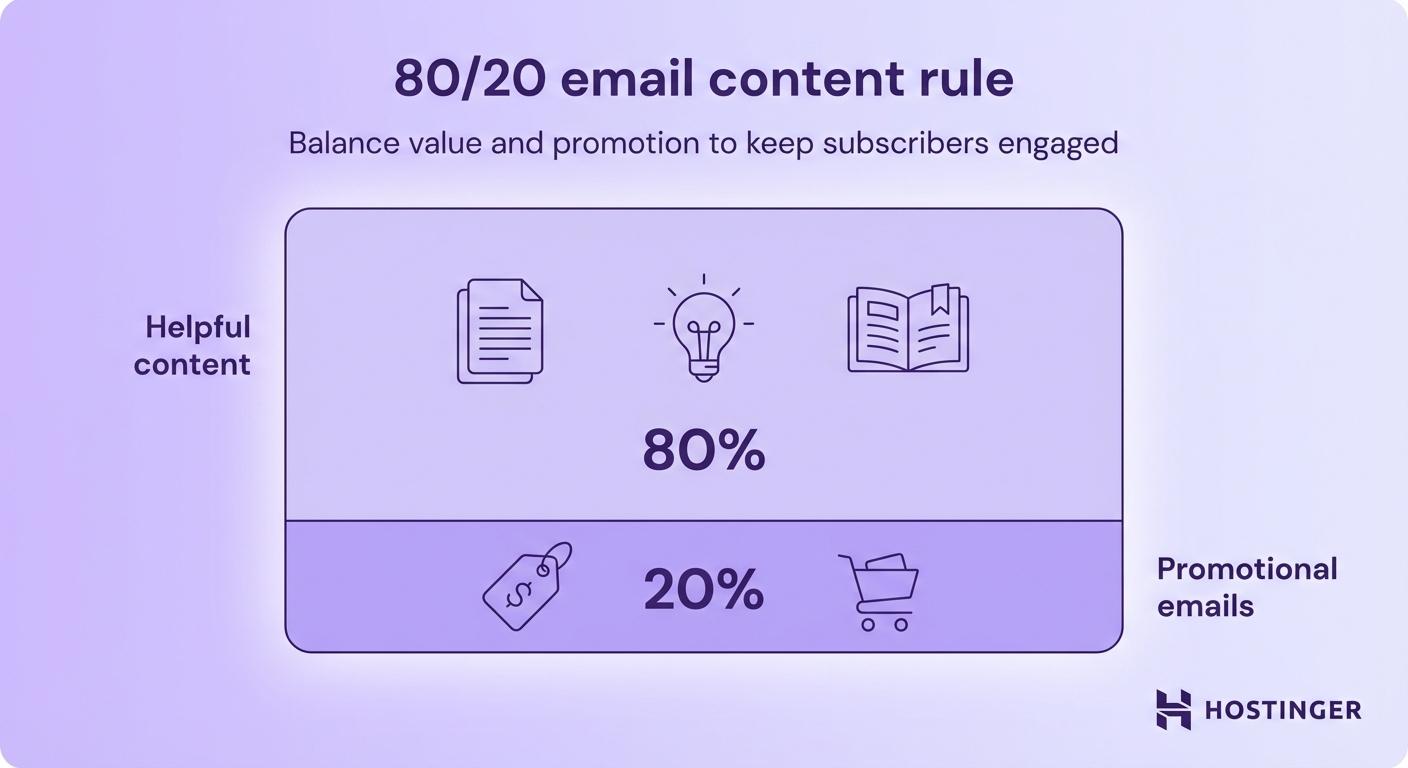
If every message screams “Buy now,” your subscribers tune out fast, and many will unsubscribe. That’s where the 80/20 rule comes in: spend about 80% of your emails sharing tips, resources, or advice, and 20% on selling. That ratio keeps your audience engaged without making them feel like they’re constantly being sold to.
So what counts as useful content? It depends on your audience, but these formats consistently perform well:
- Newsletters with tips and curated resources – share insights your audience can act on right away. Even a single useful tip per email builds loyalty over time. Following solid email newsletter best practices – like format and how often you send – helps you stay consistent without burning out your list.
- Product updates – only when you have something genuinely new to share, not just a reason to fill an inbox.
- Exclusive offers – early access to a sale or a subscriber-only discount gives people a concrete reason to stay on your list.
- Tutorials and how-to content – position you as someone worth listening to, which makes your promotional emails more effective when you do send them.
Subject lines matter more than most people realize. Your email could contain the best advice you’ve ever written, but if the subject line doesn’t spark enough curiosity, nobody opens it. Keep subject lines short, specific, and benefit-driven. “3 ways to cut your ad spend this week” beats “Our latest newsletter update.”
3. Use affiliate marketing in emails
Affiliate marketing lets you earn commissions by recommending products your subscribers are already looking for. You share a special tracking link, a reader clicks and buys, and you get a percentage of the sale.
If you’ve already started an affiliate marketing side income through a blog or website, email gives you a direct line to the same audience – without relying on search traffic or social algorithms to get your recommendations seen.
The key to promoting affiliate links is relevance. If you run a fitness blog, your subscribers expect recommendations for workout gear, supplements, or training apps, not random kitchen gadgets. The closer the affiliate product matches your audience’s interests, the higher your click-through and conversion rates.
You also want to weave affiliate links into your content naturally. Instead of a standalone “check out this product” email or a random promotional blast, include the recommendation as a helpful tip, a product comparison, or a personal experience.
A good email marketing campaign for affiliates mixes helpful content with promotions, so readers never feel like they’re just being sold to. Here’s how that can look:
- Inside a tip – “For better sleep, I switched to [product]. Here’s what changed after two weeks.”
- In a comparison – “I tested three budget podcast mics. Here’s which one sounded best.”
- As a resource list – “Five tools I use every week to manage client projects.”
You need to disclose affiliate links – it’s required by regulations like the FTC’s endorsement guidelines. If you earn a commission when someone buys through your link, your readers should know.
You don’t need legal terms, just a clear line near the top or before the links, for example: “This email contains affiliate links, which means I may earn a small commission if you buy something.” Being upfront about this builds trust, because subscribers can see you’re being transparent about how you make money.
4. Sell your own products or services
Selling your own products or services gives you the highest earning potential because there’s no middleman taking a cut. Whether it’s a digital download, a physical item, or a consulting package, your subscribers already know and trust you, which makes them your most likely buyers.
If you sell digital products like online courses, ebooks, templates, or printables, email is an especially strong channel. The delivery is instant, there’s no shipping cost, and on a $30 ebook, you keep nearly all of that money.
The same email marketing strategies for ecommerce work for physical products and services too, because you’re selling to people who have already chosen to hear from you.
Where email really shines is the launch sequence. Instead of sending one “here’s my new product” message, build anticipation over five emails:
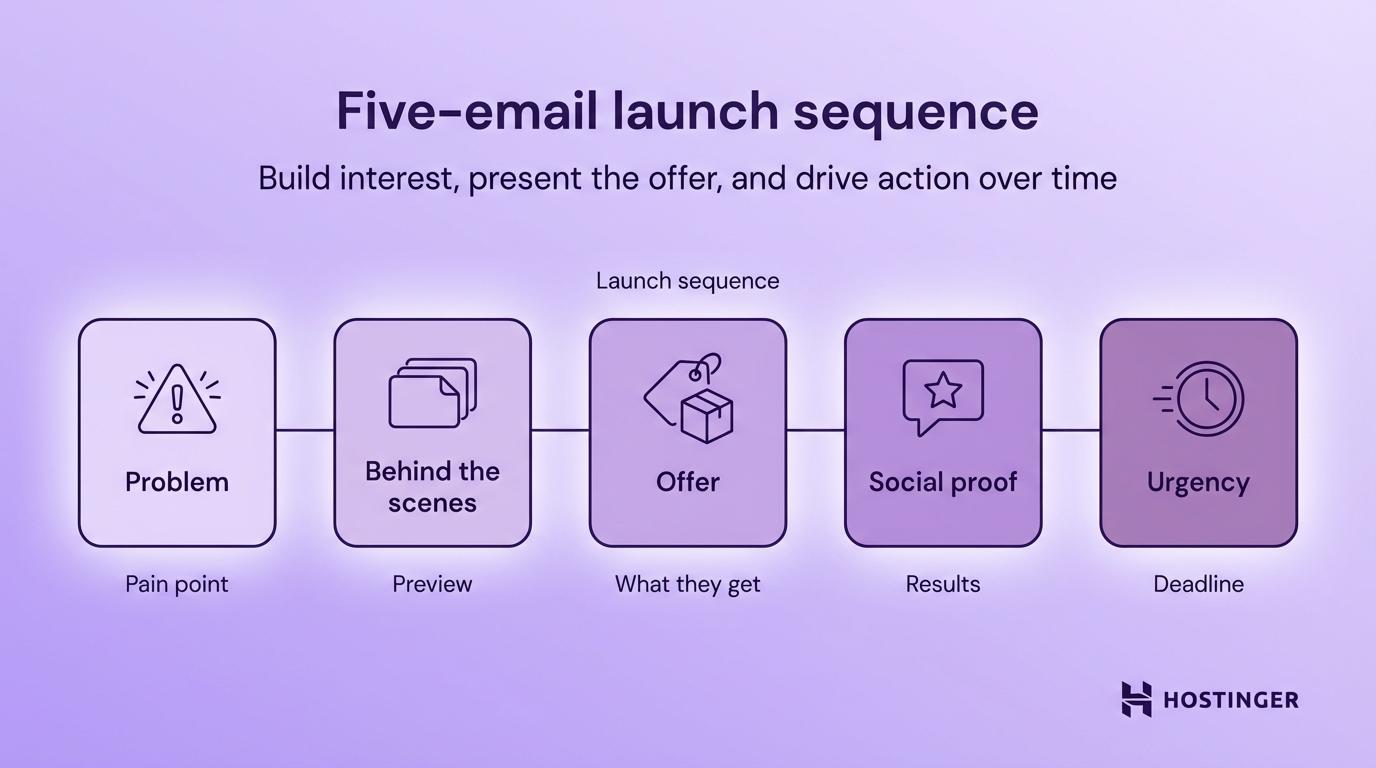
- Start with the problem – describe the challenge your product solves. Let subscribers see themselves in it.
- Share a behind-the-scenes look – show early results, your process, or a preview of what’s coming.
- Open with a clear offer – present the product, the price, and exactly what they get.
- Follow up with real customer results – share testimonials, reviews, or early buyer experiences.
- Close with urgency – a genuine deadline or limited availability gives people a reason to act now.
That five-email series consistently outperforms a single announcement because each message does a different job.
Exclusive email-only offers create a sense of belonging for your subscribers. A discount code that only your list gets, or early access to a product before it goes live publicly, gives people a reason to stay subscribed.
Using automation to boost sales takes this even further. A well-built welcome series can introduce new subscribers to your best content, warm them up, and guide them toward a purchase within the week – all without you lifting a finger after the setup.
Once you have more than one automated series running, revenue starts building in the background while you focus on creating the next thing.
5. Offer premium subscription content
Premium content subscriptions like paid newsletters turn your expertise into a recurring income stream. Instead of earning once per sale, you earn every month for as long as subscribers stay.
This model works best when you can offer something people can’t easily find for free, like industry analysis, curated data, insider tips, detailed research reports, or exclusive tutorials. The bar for paid content is higher than for free content – subscribers expect consistent quality and unique insights they can’t get anywhere else.
Creating paid newsletters is pretty straightforward once you have a clear angle and audience, but the content itself needs to earn its price tag every single issue. Pricing depends on your niche and the depth of content you provide:
Price range | Best for | Example content |
$5–$10/month | Broad audiences, lifestyle niches | Weekly curated tips, resources, and insights |
$10–$20/month | Professional or business audiences | Industry analysis, case studies, templates |
$20–$50+/month | Specialized niches (finance, data, legal) | Research reports, proprietary data, investment ideas |
Start on the lower end to build your subscriber base, then adjust as you prove the value. Many creators offer a free tier alongside a paid one, so readers can get a taste before committing.
The biggest challenge with paid subscriptions is churn, which is people unsubscribing or leaving after a month or two. You reduce churn by delivering value consistently and reminding subscribers why they signed up. A quick monthly recap of what they received, or an exclusive bonus for long-term subscribers, helps retention.
The goal is to make people feel like canceling their subscription would mean missing out on something they can’t get elsewhere.
Pro Tip
Before committing to a full paid newsletter, send a few free issues in the premium style you're planning. Track open rates, replies, and engagement. If people are actively reading and responding, that's a strong signal they'll pay for it. If the interest isn't there yet, refine your angle before adding a paywall.
6. Let email marketing services and tools do the heavy lifting
You can have the best email strategy in the world, but if you’re manually sending every campaign and guessing what works, you’ll burn out before you see results. That’s where email marketing tools come in – they handle the repetitive and technical work so you can spend your time on content and strategy.
When you’re picking a platform, focus on the features that can save you the most time:
- A drag-and-drop email editor so you can build clean, professional emails without knowing a single line of code. If you’re staring at a blank screen, wondering where to start, this is what gets you past it.
- Automated email sequences that send welcome emails, follow-ups, and reminders on their own. You set them up once, and they keep working while you focus on something else.
- A/B testing that lets you try two subject lines on a small group, then sends the better one to everyone else. No guesswork – just a quick test that tells you what your subscribers actually respond to.
- Subscriber grouping so you can sort contacts by interest, behavior, or purchase history. The result is that every email feels relevant to the person reading it, which means more opens and clicks.
- Simple, clear reporting where you can see opens, clicks, and revenue at a glance. If you need to click through five screens to find your results, the tool is working against you.
Be realistic about what you need now versus what you need later. A solo creator with 500 subscribers doesn’t need complex software with a price tag to match. Start with a tool that fits your current size and budget, then upgrade as your list and revenue grow. Money spent on features you won’t touch for another year is money better spent on growing your list.
Hostinger Reach is a great AI email marketing platform if you want to skip the setup headaches. It uses AI to create on-brand, mobile-friendly emails from a short description of your campaign idea, so you’re not staring at a blank screen. It also connects directly with Hostinger Website Builder and WordPress, so new subscribers from your site sync to your email list automatically.
7. Run promotional campaigns and flash sales
Regular emails build trust over time, but sometimes you need a faster result. A well-timed promotional email can bring in more money in a single day than a week of regular content. Flash sales and limited-time offers work because they give subscribers a specific reason to act right now.
When people know an offer ends at midnight or that only 50 spots are available, they make a decision instead of bookmarking it for later. And “Later” usually means “never” in email marketing.
Your promotional email needs three things to work:
- A subject line that shows the deal and the deadline – something like “24 hours only: 40% off everything.” Vague subject lines get ignored.
- A clean email body that gets to the offer fast – within the first two sentences. No long backstories. No slow build-ups.
- A single, clear call-to-action (CTA) button – one action, one button. Multiple buttons split attention and lower clicks.
Timing matters. Send the announcement email when the sale starts, a reminder halfway through, and a final “last chance” email a few hours before it ends. That three-email structure catches people at different moments in their day without overwhelming them.
After every campaign, review what performed and carry those lessons into the next one – more on how to do that in the section below.
Pro Tip
Don't run flash sales too often. If your subscribers get a "limited-time" offer every week, they stop treating it as urgent and start waiting for the next discount instead of buying at full price. Reserve promotional campaigns for genuine occasions to keep their impact strong.
8. Track performance and optimize campaigns
Sending emails is only half the job. The other half – the part most people skip – is figuring out what actually worked. Tracking your performance metrics for email marketing shows you exactly where to improve, instead of just guessing.
These are the four metrics that you should keep an eye on:
Metric | What it tells you | What to aim for | If it’s low, fix this |
Open rate | How many subscribers see your content | 20%–30% | Test better subject lines with A/B testing |
Click-through rate (CTR) | How many people clicked a link inside your email | ~2% average across industries | Make your content more specific, or move your CTA button higher in the email |
Conversion rate | How many clickers took the action you wanted | Start at 1%, then grow from there | Check your landing page, not just the email |
Revenue per email | The actual dollar return of each campaign | Track it per campaign and aim to grow it monthly | Match offers more closely with subscriber interests |
The key habit here is diagnosing the right problem. Low opens means your subject lines need work, not your email content. Strong clicks but weak sales means your landing page is where people are dropping off, not the email. Knowing where the problem actually sits saves you from fixing the wrong thing.
Send time also affects results. Many beginner marketers send when it’s convenient for them, not when their subscribers are actually checking email. Test different days and times – even shifting from a Monday morning to a Tuesday afternoon can make a noticeable difference.
Review your numbers after every campaign, even if it’s just five minutes. Over time, those small improvements add up to significantly better returns.
How to choose the right email marketing platform for your business
Knowing what to send and how to monetize your list only matters if the platform behind it can keep up. The best choice depends on where you are right now: your list size, your budget, and how much of the work you want to automate.
Most platforms charge based on the number of contacts or emails sent per month. Email marketing costs go up as your list grows, so picking the right fit early saves you from an expensive switch later.
Here’s how a few popular email marketing platforms compare:
- Hostinger Reach is built for beginners who want AI to handle the heavy lifting. You describe your campaign idea, and it generates a professional, on-brand email ready to send in minutes. The free plan covers 100 subscribers and 200 emails per month, with paid plans starting at ₦2900.00/month.
- Mailchimp offers a free plan for 250 contacts and 500 emails per month, with paid plans starting at $13/month. It’s grown into a full marketing platform with CRM features and a large app ecosystem. Costs climb quickly as your list grows, and it counts unsubscribed contacts toward your bill.
- Brevo charges by email volume instead of contact count, so you can store unlimited contacts for free and send up to 300 emails per day. Paid plans start at $9/month for 5,000 emails. That makes it a strong option if you have a large list but don’t email it frequently.
If you’re already on a platform and thinking about switching, a little prep goes a long way. Export your full contact list – including any tags or groups you’ve set up – and rebuild your automated emails on the new platform before turning off the old one. Send to a small group first to make sure your emails are landing where they should because switching platforms can temporarily affect delivery.
Our recommended pick is Hostinger Reach. It’s the most beginner-friendly option on this list, and the only one where AI handles both the writing and the design from a single prompt. If you’re already using Hostinger for hosting or website building, everything connects without extra setup.
Whichever platform you go with, the revenue comes from what you’ve built around it – your list, your content, and how well you know what your subscribers actually want.

Alma is an AI Content Editor with 9+ years of experience helping ideas take shape across SEO, marketing, and content. She loves working with words, structure, and strategy to make content both useful and enjoyable to read. Off the clock, she can be found gaming, drawing, or diving into her latest D&D adventure.