Abandoned cart email: Best practices and examples
Apr 23, 2026
/
Larassatti D.
/
10 min Read
An abandoned cart email is a message sent to online shoppers who add products to their cart but leave the website before completing their purchase. It aims to remind potential buyers of the products they’re interested in and strengthen customer relationships through timely, personalized communication.
Cart recovery emails work by detecting when a shopper exits without checking out, then automatically triggering a follow-up sequence to encourage them to complete their order. The body content of this ecommerce email marketing type includes product images, pricing details, and clear calls to action that simplify the path back to the checkout process.
Major reasons for cart abandonment include high shipping costs, checkout friction, and slow-loading pages. Analyzing the behavior of online shoppers lets you identify what drives abandonment and create more relevant and persuasive recovery messaging.
You can boost your abandoned cart recovery rate by following best practices for abandoned cart emails, such as utilizing personalization, crafting compelling subject lines, offering strategic incentives, and incorporating social proof or a sense of urgency.
The good news? You don’t need advanced technical skills to set this up. Modern ecommerce platforms and email automation tools make it easy to launch a recovery flow in just a few clicks.
From there, you can track key email performance metrics, such as open rates, click-through rates, and abandoned cart email conversion rate. Regularly conducting A/B testing provides you with the necessary data to continually refine and optimize your strategy.
What is an abandoned cart email?
An abandoned cart email is an automated follow-up sent to shoppers who leave your site without completing their purchase after adding products to their cart. This email marketing campaign type serves as a sales recovery tool, prompting customers to return to your site and complete their purchase. It often features product images, clear calls to action (CTA), and incentives to motivate shoppers to finalize their orders.
While similar to an abandoned checkout email, which targets users who begin the final payment process but don’t finalize it, a shopping cart abandonment email reaches potential customers earlier in the buying journey.
You can re-engage hesitant buyers and motivate them to complete their purchase by reminding them about the items they left behind. In fact, data from Flowmium shows that 3.33% of customers go on to finalize their orders after clicking on a cart abandonment email.
New to email marketing?
Our email marketing guide explains how it works, outlines the various types of campaigns you can create, and highlights the key pros and cons to consider.
Common reasons for shopping cart abandonment
According to Baymard Institute’s Cart Abandonment Statistics, these are the most common reasons for cart abandonment among online shoppers:
- High shipping cost. Unexpected fees at checkout are among the top deal-breakers for customers. When the final total is higher than expected, many online shoppers abandon their carts instead of completing the purchase.
- Checkout friction. Complicated checkout processes that involve too many steps, form fields, or account creation often discourage buyers. Simplifying the process and offering guest checkout options eliminates this barrier and improves conversions.
- Limited payment options. If a store doesn’t support customers’ preferred payment methods, they may leave to find a more flexible retailer. Offering multiple secure payment options caters to diverse online shopping behaviors.
- Slow website performance. Long loading times or technical glitches during checkout can frustrate users and lead to lost sales. A fast and mobile-friendly experience is crucial to reducing cart abandonment rates.
What is the key difference between abandoned cart email and abandoned checkout email?
The main difference between an abandoned cart email and an abandoned checkout email lies in the stage at which the shopper leaves the purchase journey.
An abandoned cart email is triggered when a customer adds products to their shopping cart but leaves the site before beginning the checkout process, indicating interest but not yet commitment.
An abandoned checkout email is sent when a customer starts entering checkout details but exits before completing the purchase, showing stronger buying intent.
Both emails are forms of cart abandonment recovery, but they target different types of online shoppers’ behavior.
What are the key components of an effective cart recovery flow?
An effective cart recovery flow relies on three key components: timing, frequency, and segmentation. Together, these elements ensure that your abandoned cart email sequence feels timely, relevant, and persuasive, maximizing your chances of recovering lost sales.
| Component | Description | Best practices |
| Timing | Refers to the moment the first email in your abandoned checkout flows is sent | – Send the first message 1-2 hours after abandonment to catch the shopper while their interest is still high – Follow up with a reminder 24 hours later if they haven’t returned |
| Frequency | Determines how many emails are included in your abandoned checkout flows | Use a three-email sequence: – Initial reminder – Follow-up with social proof or a sense of urgency – Final message offering an incentive if appropriate |
| Segmentation | Involves targeting emails based on customer behavior, cart value, or purchase history | Segment users by cart size, new vs returning status, or product type to personalize messaging and increase engagement |
Consider automating your email campaigns to ensure every message arrives at the right time, making your recovery process more efficient and consistent.
Best practices for abandoned cart email campaign
The most effective abandoned cart email campaign best practices combine personalization, compelling design, and persuasive copy to re-engage shoppers. Below are abandoned cart email best practices that separate average reminders from solid strategies.
1. Personalize based on cart contents and behavior
Personalized abandoned cart emails feel more relevant and engaging. Go beyond inserting the recipient’s first name – use ecommerce personalization to tailor every element of the email to their specific interests and browsing habits.
Here are four email elements you can personalize in your abandoned cart messages:
- Product details. Include product thumbnails, names, and even color or size options to jog the customer’s memory.
- Pricing. Show current discounts or price drops since the user last viewed the item.
- Incentives. You can adjust the promotional offers based on user behavior. For instance, frequent shoppers appreciate loyalty points reminders, while new visitors may respond better to a first-time buyer discount.
- Recommendations. Add “You may also like” or “Complete your look” sections to cross-sell complementary products.
This level of product-based email content improves engagement and reinforces the emotional connection the shopper already had with the product.
2. Create compelling subject lines and CTAs
Your abandoned cart email subject line determines whether the customer opens your message, as it’s the first thing they’ll see in their inbox. Make it count by focusing on clarity and emotional pull. Effective subject lines spark curiosity, convey urgency, or highlight value, all while staying true to your brand’s voice.
Examples of strong cart abandonment subject lines include:
- You forgot something – and it’s still waiting for you 🛒
- Still thinking it over? Here’s a little something to help.
- Hurry! Your cart will expire soon!
- Your favorites are almost gone!
Once your subject line gets the email opened, it’s time for your call to action (CTA) to drive the conversion. Your goal is to make the next step unmistakable and compelling. Use clear, action-driven copy such as “Return to Cart,” “Check Out Securely Now,” “Claim My Discount,” or “Finish My Order.”
3. Offer discounts or free shipping
Incentives like an abandoned cart discount code or a free shipping offer tip the scales for undecided customers. They add a gentle nudge toward checkout without coming across as pushy.
That said, relying too heavily on discount offers can harm your long-term results. Overusing discounts may condition shoppers to abandon their carts intentionally and wait for a better deal to arrive in their inbox.
A coupon code offer in a cart recovery campaign can also lower your brand’s perceived value, especially if customers start associating your products with constant sales or markdowns. Moreover, it can attract deal-seekers who are less likely to become loyal customers.
If you want to implement this strategy while avoiding its pitfalls, start by giving a subtle, friendly reminder that highlights the items the shopper left behind. Then, introduce a cart recovery offer in your follow-up message.
Run A/B tests with different types of incentives to identify what resonates most with your audience. For instance, offer two types of incentives to an audience segment within a specific time frame, and see which one converts better.
It’s also wise to reward loyalty rather than relying on blanket discounts. Consider offering exclusive perks to returning customers, such as member-only savings or bonus points. This way, you maintain your brand’s perceived value while fostering long-term relationships.
4. Add social proof and urgency
Social proof shows that others trust your brand, while urgency gives shoppers a compelling reason to act now rather than later. Together, these two factors provide a combination of reassurance and motivation.
Adding social proof works because people naturally look to others’ experiences to validate their own choices. In email marketing, this can be as simple as showcasing that others have already purchased and loved the product your customer left behind.
Here’s how to use social proof effectively in abandoned cart emails:
- Highlight customer reviews and star ratings. A few authentic testimonials reinforce that real people trust the product.
- Feature user-generated content. Include real photos or short quotes from satisfied customers to humanize the product and make it feel more relatable.
- Leverage credibility markers. Showcase influencer endorsements, media mentions, or trust badges such as “Best Seller” or “Trending Now.” These signals assure the customer that they’re making the right choice.
After building trust through social proof, adding urgency drives action. Subtle scarcity cues and time-limited offers are common scarcity tactics in ecommerce that inspire quicker decisions.
You can add urgency in your abandoned cart emails using:
- Countdown timers that show exactly how long the discount or item availability lasts (“Your 10% off expires in 2 hours!”).
- Low-stock alerts, such as “Only 3 left in stock” or “Selling fast!” to make buyers aware of limited availability.
- Time-sensitive incentives like “Order before midnight for free shipping” or “Reserve your cart before it’s gone.”
Abandoned cart email examples
We’ve selected these abandoned cart email campaign examples based on how well they follow email marketing best practices. Each one highlights a different approach you can adapt to fit your own brand and audience.
1. B&Q
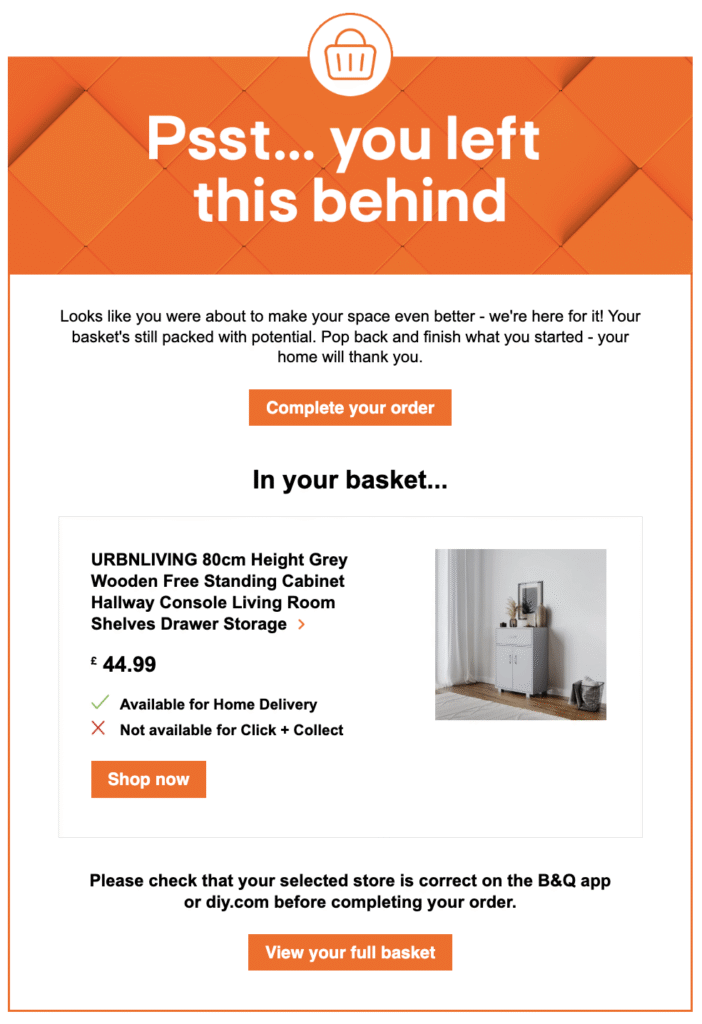
B&Q’s abandoned recovery cart email focuses on the positive outcome their customers will get by completing the purchase. The body email stating “Looks like you were about to make your space even better” taps into a stronger emotional motivation than price alone.
The campaign instantly reminds the customer about the product they’re interested in by showcasing the specific product image and details. It then removes friction points by clearly stating the item is “Available for Home Delivery,” addressing any logistical concerns that may have caused the abandonment.
2. Roaman’s
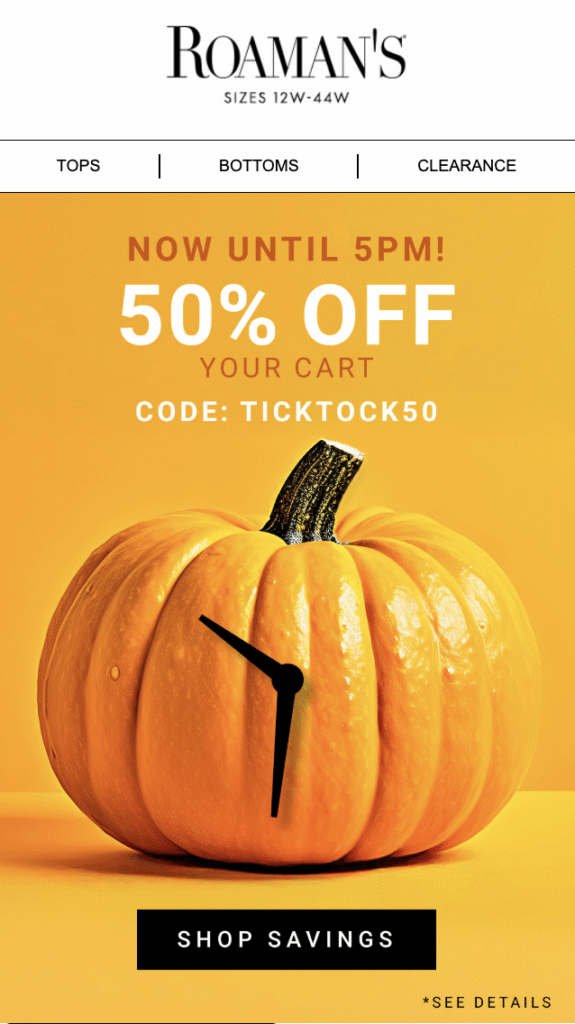
Roaman’s campaign effectively combines time sensitivity and a discount offer to prompt quick action. The use of seasonal Halloween imagery featuring a clock-faced pumpkin instantly grabs attention and fosters a sense of urgency.
By setting a clear time limit and reinforcing it through visuals and copy, Roaman’s creates a subtle fear of missing out. This strategic blend of abandoned cart email design and messaging nudges hesitant shoppers to complete their purchases before the deal ends.
3. Sam Edelman
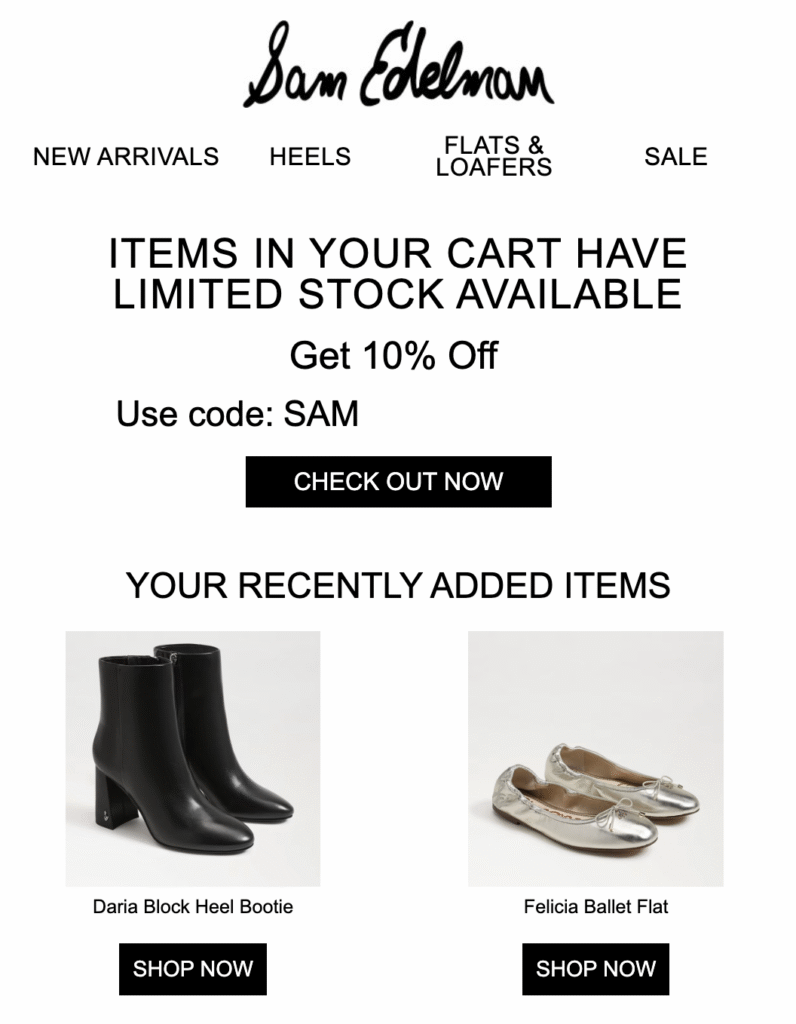
Focusing on scarcity and urgency, Sam Edelman takes a slightly different approach to encouraging customers to complete their purchases. Instead of relying solely on thematic visuals, the brand highlights the exact items left in the customer’s cart. The email also features more product categories to explore, inviting shoppers to discover new items beyond their initial selections.
Paired with clear messaging about limited availability and a bold “SHOP NOW” CTA button, this email strikes a thoughtful balance between persuasion and personalization.
4. Table Covers Now
Table Covers Now builds a connection with a personalized, lighthearted tone to re-engage customers who left an item in their cart.
Instead of pressuring the customer with stock warnings or flash sales, the email employs a playful, non-judgmental approach in its copy. This conversational style humanizes the brand, making the message feel like a friendly reminder from an understanding peer.
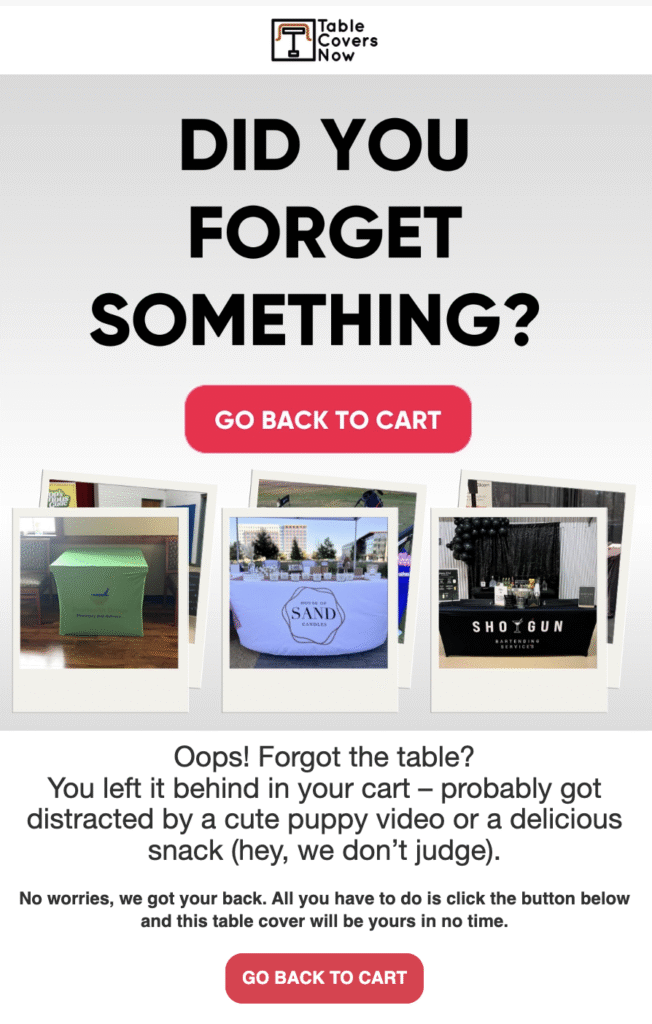
Additionally, to ease hesitation and address post-abandonment friction, the email leverages social proof by featuring images of their covers being used by other businesses.
It concludes with a bold “GO BACK TO CART” CTA highlighted in an eye-catching red to draw focus and guide users toward completing their purchase.
What are the best tools to set up abandoned cart emails
Many leading ecommerce website builders come with built-in email marketing features, allowing you to manage all your selling needs within the same platform.
For example, if you build an online store with Hostinger Website Builder, you can integrate Hostinger Reach into your ecommerce site.
From there, you can sync your email list captured from your site, easily create campaign email templates with the help of AI, and automate email send times. WordPress users can also integrate Hostinger Reach by installing the plugin from the official repository.
If you’re using another ecommerce builder, use an email marketing tool to set up abandoned cart recovery emails for your store. Most modern solutions offer seamless integration, either directly within the platform or through an application programming interface (API).
Popular ecommerce-focused tools like Omnisend and Klaviyo have advanced automation, segmentation, and reporting capabilities designed to maximize recovery rates.
However, their extensive feature sets often come with higher pricing, making them best suited for growing or established online stores ready to invest in more advanced marketing workflows.
Building your online store on WooCommerce?
Don’t miss our complete guide to re-engaging customers and recovering lost sales through abandoned cart recovery strategies on WooCommerce.
How to measure the success of cart recovery campaigns
To measure the effectiveness of your recovery flow, track key email performance metrics that highlight opportunities to optimize your cart abandonment emails.
These metrics help you understand which parts of your campaign need improvement. For instance, tracking open and click-through rates shows how engaging your subject lines and CTAs are. Meanwhile, monitoring the abandoned cart email conversion rate helps you gauge how many recipients actually complete their purchases.
Key cart recovery email performance metrics to monitor include:
- Abandoned cart email conversion rate. This measures the percentage of shoppers who complete their purchase after opening your email. The average rate is around 3%, so if yours is lower, consider refining your CTAs or testing new incentives.
- Open rate and click-through rate (CTR). Your subject lines and CTA determine whether users engage with your email. Abandoned cart emails achieve 50.5% open rates and 6.25% CTR on average, outperforming standard promotions. Experiment with wording and design through A/B testing to see what works best.
- Revenue recovered. Track how much revenue your campaign brings back versus the total value of abandoned carts.
- Unsubscribe rate. Monitor unsubscribes or complaints to ensure your follow-ups aren’t too frequent. Use segmentation to tailor frequency and tone to different buyer behaviors.
Improve these metrics by continually A/B testing subject lines, timing, and incentives. Combine this approach with audience segmentation and experiment with tone, copy, visuals, and CTAs, adjusting each element based on performance insights.
What are some other best email marketing practices?
When done right, email marketing remains one of the most effective digital marketing channels, as it allows you to own your audience list and communicate with them on your own terms. And cart abandonment recovery is just one part of a well-rounded email marketing strategy for ecommerce.
Experiment with various email marketing campaign types, such as welcome sequences, post-purchase follow-ups, re-engagement campaigns, or loyalty-driven newsletters. For inspiration, explore different newsletter examples. Each touchpoint builds trust and keeps your brand top of mind throughout the customer journey.
Following these email marketing best practices maximizes the impact of each email you send to your customers:
- Use a recognizable sender name and reply-to address. Your audience should instantly recognize who the message is from. This builds trust and improves engagement compared to generic or unfamiliar sender names.
- Avoid spammy words in subject lines and write clear preview text. Words like “free,” “limited-time offer,” or overly aggressive language can trigger spam filters or deter readers. Instead, use clear, relevant language and concise preview text that teases value.
- Segment your list and send behavior-triggered emails. Tailor messages based on how subscribers interact with your brand (new vs. returning, shopping behavior). Triggered emails, such as abandoned cart reminders or behavior-based follow-ups, perform much better than generic blasts.
- Ensure your templates are mobile-friendly and focus on one clear CTA. A responsive design, easily tappable button, and one prominent call-to-action guide the reader to take your desired action.
- A/B test and track your campaigns for continuous improvement. Set clear goals for what you want to achieve with your series of email blasts. Then, test subject lines, send times, layouts, and content to determine which ones perform well. Use that data to optimize the next wave of campaigns.
If you haven’t implemented an email marketing strategy before, it’s perfectly fine to start small by experimenting with one or two types and observing what resonates with your audience. Over time, you can expand your goals, automate workflows, and fine-tune your content based on real performance data.

Larassatti Dharma is a content writer with 4+ years of experience in the web hosting industry. She has populated the internet with over 100 YouTube scripts and articles around web hosting, digital marketing, and email marketing. When she's not writing, Laras enjoys solo traveling around the globe or trying new recipes in her kitchen. Follow her on LinkedIn