What is the best time to send marketing emails?
May 04, 2026
/
Ksenija
/
8 min Read
The best time to send marketing emails is Tuesday to Thursday between 9–11 AM or 1–3 PM, as people are more likely to check and engage with emails during active work hours.
That said, the best time to send marketing emails still depends on the audience, industry, and user behavior.
Some audiences respond better in the morning, while others engage later in the day, so these time windows act as a starting point rather than a fixed rule.
Timing directly affects performance. Emails sent when inbox competition is lower, and users are actively checking messages, are more likely to be opened, clicked, and acted on. Time zones also play a role, especially for global audiences.
To refine the send time, use audience segmentation and A/B testing. Test different days and time slots, measure engagement metrics like click-through rates, and adjust based on what works for your audience.
What is the best day and time to send marketing emails
The best day and time to send marketing emails is midweek, Tuesday to Thursday, during late mornings or early afternoons, around 9–11 AM or 1–3 PM.
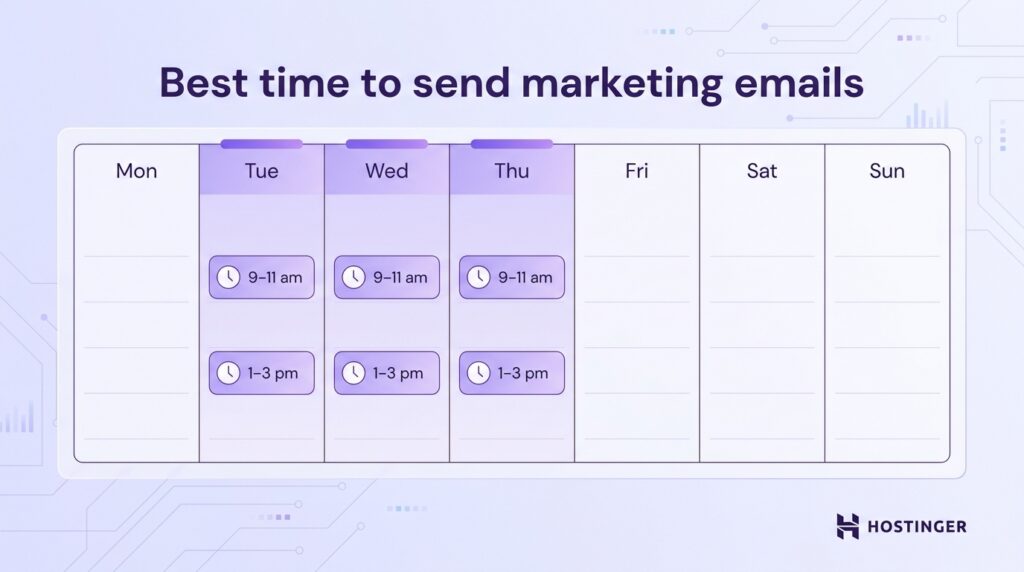
The “best time” combines two factors: the day of the week and the time of day. Email performance improves when messages arrive while people are actively checking their inbox and have time to read and respond. That usually happens during working hours, when attention and routine align.
These benchmarks give you a reliable starting point, but results shift based on your audience, industry, and schedule.
Use them as a baseline, then adjust based on real engagement data. Your send time should match your overall email marketing strategy and how your audience behaves throughout the week.
What is the best day to send marketing emails
Based on Campaign Monitor’s email marketing benchmarks research, the best days to send marketing emails are Tuesday, Wednesday, and Thursday, with Tuesday leading in click-through rates (2.4%) and Wednesday and Tuesday sharing the highest click-to-open rates (10.8%).
Performance stays relatively consistent across weekdays, but there are some small differences.
Monday records the highest open rate (22.0%), which shows strong inbox activity at the start of the week. Midweek shifts toward higher engagement, as users move from catching up on emails to taking action.
Engagement tends to drop on weekends, where both open and click rates are lower overall. Some industries still perform well during this time. Ecommerce and travel brands often see stronger activity when users have more time to browse and make decisions.
Unsubscribe rates remain stable at around 0.1% throughout the week, so performance differences come from engagement rather than opt-outs.
What is the best time of day to send marketing emails
The best time to send marketing emails is late morning between 9–11 AM or early afternoon between 1–3 PM, when people are active, checking messages, and more ready to engage.
Morning emails work well because many users review their inboxes when they start the day. This window fits updates, newsletters, product announcements, and B2B emails that need attention during work hours.
Early afternoon can also perform well because users return from lunch and catch up on messages before the day gets busy again. This timing works well for offers, reminders, event promotions, and emails that call for a clear action.
Evenings work better for mobile-heavy audiences. People may browse personal emails after work, especially for ecommerce, travel, entertainment, and lifestyle content.
Desktop engagement is stronger during work hours, while mobile usage rises during commutes, breaks, and evenings.
Use 9–11 AM and 1–3 PM as starting points, then test against your own audience data. Send the same type of email at different times, compare open rates, click-through rates, and conversions, and keep the time window that brings the strongest response.
When is the best time to send marketing emails by industry
B2B emails work best during weekday mornings and early afternoons, B2C and ecommerce emails see higher engagement in the evenings and on weekends, and media emails gain the most traction in the early morning.
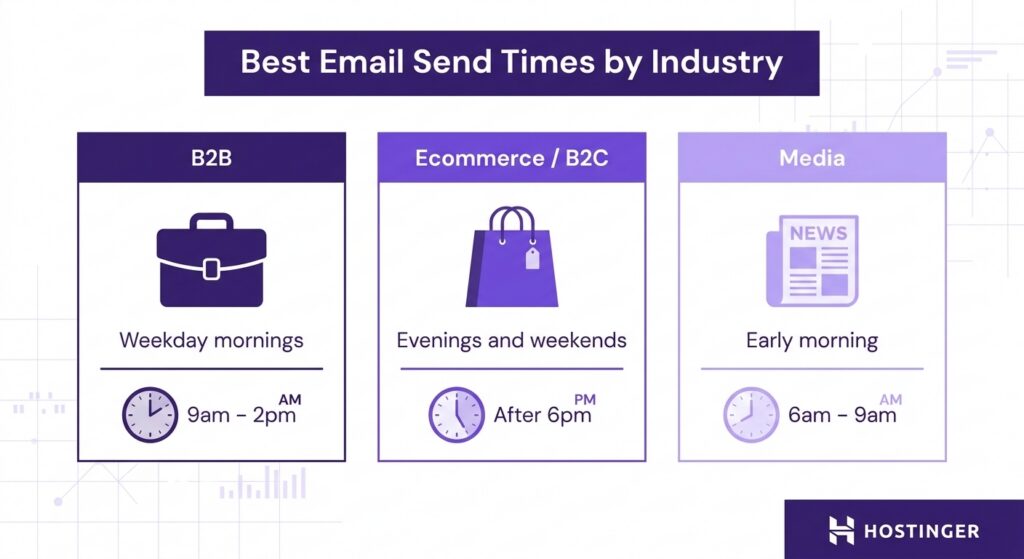
These differences come from how each audience uses email throughout the day. Work-focused users check messages during office hours, while consumers engage more during free time. Content readers follow daily habits, often checking updates early in the morning.
Industry benchmarks give you a starting point, but results improve when you adjust timing based on your own audience data. Track engagement, test different time slots, and refine your schedule over time.
Ecommerce and retail
Ecommerce emails see stronger engagement in the late afternoon, evening, and on weekends, when users are more likely to browse products and complete purchases.
Shopping activity often happens outside working hours, especially on mobile devices. For example, an ecommerce brand might send a discount email at 7 PM, when users are relaxing and scrolling on their phones.
Weekend campaigns also capture higher browsing intent, particularly for promotions, product launches, and seasonal sales.
Timing should also match specific buying moments. Holiday campaigns, flash sales, and limited-time offers perform better when they align with peak shopping periods.
For stronger results, adjust your ecommerce email marketing strategy so you schedule emails based on your store’s sales data and customer purchase behavior, such as when past orders or peak traffic occur.
B2B companies
B2B emails perform best during weekday mornings and early afternoons, when professionals actively check their inbox as part of their workday.
Most engagement happens between 9 AM and 2 PM, before calendars fill with meetings and deadlines. Emails sent during this window fit into routine tasks like reviewing updates, replying to requests, or evaluating tools.
Engagement usually drops in the evening and on weekends, when work-related communication slows down.
An effective marketing strategy for B2B companies matches send times to work routines and focuses on clear actions like demos or follow-ups.
B2C brands
B2C emails see higher engagement in the evening and on weekends, when consumers have more free time to browse offers and content.
Engagement often increases after 6 PM, when people shift from work to personal activities. Lifestyle products, travel deals, and entertainment offers benefit from this timing because users are in a browsing mindset rather than a task-focused one.
Audience segments shape results. Younger audiences may engage later in the evening, while older groups often check emails earlier. So, it’s best to adjust timing based on how your specific audience interacts with your brand.
Media and content publishers
Media and content emails perform best in the early morning, when users check news, updates, and newsletters at the start of the day.
Sending between 6 AM and 9 AM aligns with habits like reading emails during breakfast or commuting. Consistency improves results. Daily or weekly newsletters perform better when sent at the same time, so readers know when to expect them.
Content type also affects timing. Breaking news performs best early in the morning, while long-form articles or deep reads often get more engagement later in the day, when readers have more time to focus.
Why the right email send time matters
The right email send time determines whether your message appears when people are ready to engage or gets buried under newer emails.
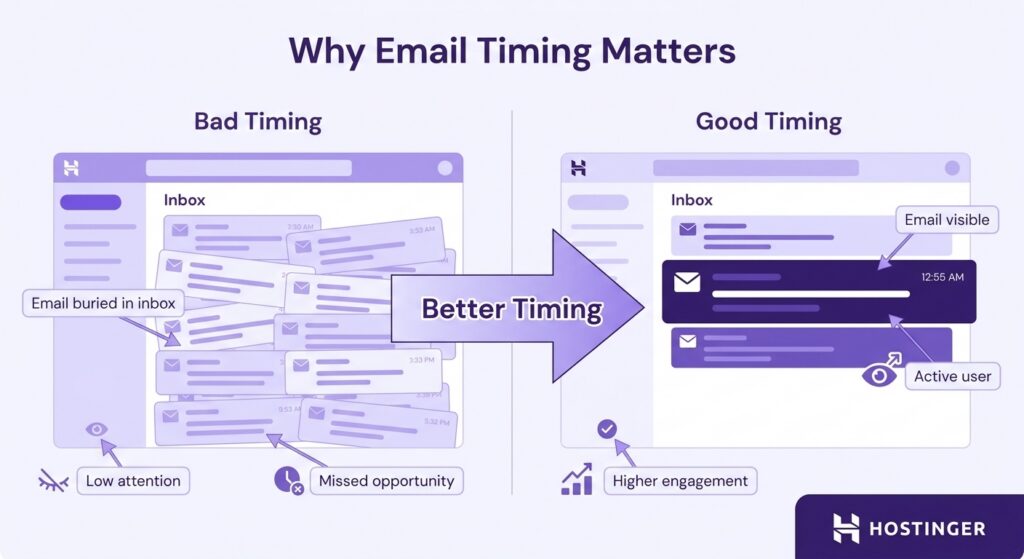
Inbox competition builds quickly throughout the day, so an email sent during a low-attention period can be missed before the recipient ever sees it.
User habits shape engagement. Office workers often check emails during morning planning or early afternoon catch-up periods. Shoppers may browse promotional emails in the evening or on weekends. Newsletter readers may open updates early in the day as part of their routine.
Time zones add another layer. A campaign sent at 9 AM in one country may arrive overnight for subscribers in other countries. For global lists, sending by local time helps emails reach people when they are awake, active, and more likely to respond.
Timing affects open rates, click-through rates, and conversions by controlling the moment of attention. Even strong subject lines, useful content, and clear offers can underperform when the email arrives at the wrong time.
How to determine the best send time for marketing emails
Determining the best send time for marketing emails requires email analytics, A/B testing, and ongoing optimization based on real audience behavior.
Start with your own campaign data. Review when subscribers open, click, and convert, then use those patterns to test better send times. Keep refining your schedule as your audience grows, seasons change, and campaign goals shift.
1. Analyze audience behavior data
Review past campaign performance to find your strongest engagement windows. Look at open rates, click-through rates, and conversions by day and hour.
Identify patterns across different audience groups. New subscribers may engage faster after signing up, while repeat customers may respond better to weekend promotions.
If your email platform allows it, compare data by location, device, customer type, or purchase history.
2. Segment your email list
Segment your email list audience by location, behavior, lifecycle stage, or customer type so each group receives emails at a time that fits their routine.
A B2B lead in London may check email during work hours, while a returning ecommerce customer in New York may engage more in the evening. Sending the same emails to both groups at the same time can weaken performance.
Segmentation also makes timing feel more personal. When emails arrive at a useful moment, subscribers are more likely to open, click, and act.
3. Consider time zones
Adjust send times based on where subscribers live. A campaign scheduled for 9 AM in one country may reach another audience in the middle of the night.
Use automation tools to send at each subscriber’s local time when your list covers multiple regions. This keeps emails out of low-attention hours and gives each audience a fair chance to engage.
4. Run A/B tests
Run A/B tests by sending the same campaign on different days or times, then compare performance.
Test one timing variable at a time. For instance, send the same email to one group on Tuesday at 10 AM and another group on Thursday at 10 AM. Then test time of day separately, such as 10 AM versus 2 PM.
Use a large enough sample to trust the result. A test with 50 recipients can swing by chance, while a larger segment gives a clearer signal.
5. Optimize and iterate
Refine your send times based on repeated results, not one campaign.
Track long-term trends, seasonal changes, and differences between campaign types. A weekly newsletter, flash sale, and onboarding email may each need a different schedule.
Document what you learn after each test. Over time, these findings turn your send-time decisions into a repeatable process instead of guesswork.
How to optimize your email send times
Optimizing email send times means delivering each email when a user is most likely to engage, using automation, behavioral data, and real-time signals rather than fixed schedules.
Basic scheduling and A/B testing give you a solid starting point. Optimization takes it further by adapting send times for each subscriber based on how they interact with your emails.
This approach relies on tools that track engagement patterns, predict behavior, and trigger messages at the right moment.
AI-powered send time optimization
AI-powered send time optimization uses past behavior to predict when each subscriber is most likely to open an email.
Instead of sending a single campaign to your entire list at once, the system spreads delivery across multiple time slots.
Each user receives the email when they usually engage. Someone who opens emails at 8 AM gets it in the morning, while someone who checks them at 8 PM receives it later in the day.
Tools like Hostinger Reach handle this automatically. This email marketing tool analyzes open history, click patterns, and activity trends, then schedules delivery for each recipient. This improves visibility without requiring manual testing for every segment.
Behavioral trigger-based sending
Behavioral trigger-based sending delivers emails based on what users do, rather than when you schedule a campaign.
Actions like visiting a product page, clicking a link, or completing a purchase can trigger a follow-up email.
A user who views a product might receive a reminder within a few hours, while someone who abandons a cart may get a discount the same day.
This approach aligns timing with intent. The email arrives when the action is still fresh, which increases the chance of engagement and conversion.
Real-time personalization
Real-time personalization continuously adjusts send times based on how each user interacts with your emails.
If a subscriber starts opening emails later in the day, the system shifts delivery to match that new pattern. Timing evolves alongside behavior, rather than staying fixed based on past data.
This method works best when combined with personalized content. An email sent at the right time and tailored to the user’s interests creates a stronger connection and encourages action.
How to measure and improve your email marketing performance
Measuring and improving email marketing performance starts with tracking how your emails perform after delivery and using that data to refine your timing and content.
Focus on key metrics that show how people interact with your emails.
- Open rates show how many recipients noticed and opened your message.
- Click-through rates reveal whether the content and call to action captured interest.
- Conversion rates track how many users completed a desired action, such as making a purchase or signing up.
Engagement over time shows whether your audience stays interested or begins to lose attention.
Use these metrics to evaluate your send-time decisions. If emails sent at 10 AM receive more opens but fewer clicks, your subject line may work, while the content needs improvement.
If evening campaigns generate more conversions, that time window aligns better with purchase intent. Each metric highlights a different part of the user journey.
Track results across multiple campaigns instead of relying on a single send. Patterns become clearer when you compare performance over time, across different days, and between audience segments.
Connect timing with performance data to guide every decision. When you adjust send times, measure the impact, keep what works, and refine what does not. This turns email marketing into a continuous process based on real behavior rather than assumptions.
To go deeper, explore our guide on how to measure email marketing performance and apply more advanced tracking and optimization methods.

Ksenija is a digital marketing enthusiast with extensive expertise in content creation and website optimization. Specializing in WordPress, she enjoys writing about the platform’s nuances, from design to functionality, and sharing her insights with others. When she’s not perfecting her trade, you’ll find her on the local basketball court or at home enjoying a crime story. Follow her on LinkedIn.