How to create a Black Friday email marketing strategy
May 21, 2026
/
Jordana A.
/
8 min Read
Black Friday email marketing is a focused strategy to promote sales through emails during the year’s biggest shopping event. It’s a planned series of emails designed to build excitement, drive traffic, and boost conversions by connecting your offers with the right audience during peak season.
To achieve the best results, start preparing your Black Friday campaign at least three to four weeks in advance, ideally by the end of October. This gives you time to plan, test, and adjust your content based on performance.
Here’s how to plan a converting Black Friday email marketing strategy:
- Learn from past Black Friday campaigns. Review last year’s performance to find what worked and what didn’t.
- Plan your Black Friday emails. Outline your campaign schedule, email types, and key messages.
- Build up your email list. Use pop-ups, lead magnets, and landing pages to collect new subscribers before the campaign starts.
- Observe your audience. Learn what your subscribers are interested in by tracking their behavior or purchase history.
- Design compelling email campaigns. Write clear subject lines, include strong visuals, and highlight your best Black Friday deals.
- Automate your Black Friday campaign. Schedule emails for different stages ‒ early access, launch day, and final reminder ‒ to keep your audience engaged.
- Monitor your email performance. Monitor open rates, click-throughs, and conversions to see how your emails are performing.
- A/B test to optimize campaigns. Test subject lines, images, or CTAs to find what gets the best results and refine your strategy.
The key is in the preparation. Follow this step-by-step breakdown to make your Black Friday email marketing campaign a success. Each part will help you build a strategy that reaches the right audience at the right time and drives real results.
1. Analyze past Black Friday campaign data
Before creating a new Black Friday campaign, look back at what you’ve done before. Evaluating past Black Friday email marketing data helps you understand what worked, what didn’t, and what to improve. This insight highlights your strengths and weak spots, helping you prepare for Black Friday with a better strategy.
Here are key performance metrics and data points to review:
- Open rate. See which subject lines attracted the most attention.
- Click-through rate (CTR). Identify which emails drove the most engagement.
- Conversion rate. Track how many people completed a purchase after clicking your email.
- Unsubscribe rate. Spot any emails that may have turned off your audience.
- Send time and day. Note when your emails performed best.
- Top-performing products or deals. Focus on items that generated the most interest or sales.
- Audience engagement by segment. Compare how different subscriber groups responded.
2. Plan your Black Friday email campaigns
A successful Black Friday email strategy starts with a solid plan. Map out what to send before, during, and after the Black Friday weekend to keep your audience engaged throughout the entire sales cycle.
Here are some ideas for your plan:
- Before Black Friday. Send teaser emails to build anticipation. Highlight early access deals, exclusive previews, or wishlist reminders to warm up your list.
- During Black Friday. Launch your main promotional emails. Focus on urgency with limited-time offers, best-seller highlights, and countdowns.
- After Black Friday. Follow up with thank-you emails, Cyber Monday offers, and last-chance deals to extend the momentum and drive more conversions.
Prepare your email schedule, outline the content and design for each send, and align it with your website and product promotions. This way, every email serves a purpose and aligns with your broader campaign goal.
3. Grow your email list
A larger, engaged email list provides more opportunities to reach buyers during Black Friday, increasing the chances of turning interest into sales. The more quality subscribers you have, the stronger your conversion base will be.
One proven way to build an email subscriber list is by offering lead magnets. They’re free resources like ebooks, checklists, or discounts that solve a real problem for your audience in exchange for their email address.
You can also boost sign-ups by placing eye-catching forms across your website with clear calls to action, adding content upgrades to your blog posts, and promoting these offers on social media. For a faster boost, run limited-time giveaways where entry requires an email sign-up, creating urgency and excitement around your campaign.
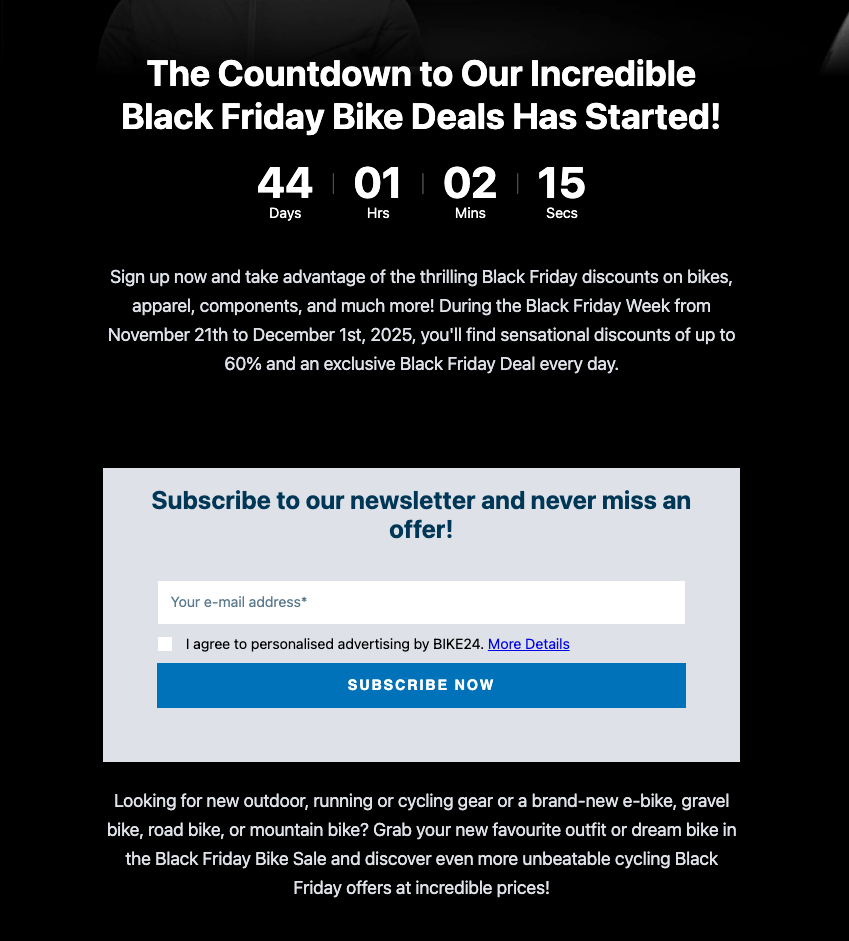
For example, BIKE24 grows its email list by placing a registration form directly on its Black Friday landing page. Visitors looking for deal updates can easily sign up and be the first to know when offers go live.
Did you know?
If your online store is built on Hostinger’s server, our email marketing platform, Reach, lets you sync subscribers from form submissions without manual exports or extra tools.
4. Understand your audience
Knowing who your audience is helps you send emails they’ll actually want to open. When you understand your subscribers’ preferences, habits, and behavior, you can create personalized Black Friday offers that feel more relevant and drive better results.
Here are the key aspects to consider when analyzing your audience for a Black Friday campaign:
- Demographics. Understand your audience’s age, location, and gender to tailor the tone, timing, and product recommendations.
- Shopping behavior. Look at how they shop during sales periods. Do they wait until the last minute? Are they more likely to buy early-access deals?
- Average order value. Knowing how much they usually spend can help you suggest bundles, upsells, or discounts that match their budget.
- Product interest. Track which products or categories they’ve browsed, clicked on, or bought before to send targeted promotions.
- Email engagement history. Review which types of emails or subject lines they respond to the most.
Utilize tools like Google Analytics to gain insight into user demographics, on-site behavior, and conversion patterns. For deeper insights, platforms like Hotjar can show how users interact with your website, while your ecommerce platform helps track purchase history and average order value.
Combining data from these sources provides a more comprehensive picture of your audience, making your Black Friday emails more precise and impactful.
5. Create appealing email campaigns
Once you’ve planned your strategy and grown your list, craft your emails. Start by choosing the right email platform. Look for one that offers easy-to-use design tools, automation features, and performance tracking. A reliable platform like Hostinger Reach makes it simple to design, send, and manage your campaigns in one place.
Next, design a professional-looking template that fits your brand and works well on all devices. Use bold headings, readable fonts, and clean layouts to keep things visually appealing.
As for the content, make it short, clear, and focused on value. Mention the exact discounts or offers upfront, use Black Friday subject lines to stand out in crowded inboxes, and create a strong sense of urgency with limited-time messages like “Ends tonight” or “While supplies last.”
Every email should include a clear call-to-action (CTA) button that guides readers to your Black Friday-ready store or landing page. Highlight your best deals and explain why subscribers shouldn’t wait.
Most importantly, optimize your emails for mobile users. With global smartphone users still dominating traffic, it’s essential that every email reads well across all devices.
If you’re new to this, check out our guide on how to create an email newsletter with Hostinger Reach for tips and best practices.
6. Set up email automation for your Black Friday campaign
Black Friday is fast-paced, and manually sending every email simply won’t cut it. Automating your email marketing helps you send the right message at the right time, saving you time and reducing errors during the year’s busiest shopping weekend.
Here are four key types of automated emails to set up for your Black Friday campaign:
- Welcome emails. Greet new subscribers instantly and let them know they’ll get early access or special deals for Black Friday.
- Abandoned cart emails. Remind shoppers of what they left behind and offer a time-limited discount to close the sale.
- Re-engagement emails. Reach out to inactive subscribers with a personalized Black Friday offer to bring them back just in time.
- Transactional emails. Automatically send order confirmations, shipping updates, and receipts to build trust and improve the post-purchase experience.
7. Track your email performance
Once your campaign is live, monitoring its performance is key to making quick adjustments and improving future results. Most email marketing platforms provide built-in analytics dashboards that make this easy.
While we’ve already covered important metrics in the first step, you’ll get the most immediate insights by focusing on three core indicators: click-through rate (CTR), conversion rate, and unsubscribe rate.
Start with your click-through rate (CTR) to see if your content and calls to action are driving engagement. Then, look at your conversion rate to see how effectively those clicks translate into actual sales. Finally, keep an eye on your unsubscribe rate. An increase could mean problems with timing, frequency, or relevance.
By focusing on these three areas, you can quickly spot opportunities to fine-tune your campaign and get better results before Black Friday ends.
8. Do an A/B test to optimize your campaign
A/B testing is a simple but effective way to improve your email marketing results. It works by sending two versions of an email to small portions of your audience. Each version has one difference, like a subject line, CTA button, or image. The version that performs better is then sent to the rest of your list.
This method helps you understand what your audience responds to best. For example, you might find that a subject line like “Early access Black Friday deals” gets more opens than “Black Friday starts now.” Or you may discover that a red CTA button drives more clicks than a blue one.
To ensure accuracy, always test one element at a time and allow the test sufficient time and a representative audience size to gather meaningful results.
What is the best time to send Black Friday emails?
The best time to send Black Friday email campaigns is at least 3-4 weeks before the big day. This early start gives you time to build awareness, warm up your list, and create anticipation before inboxes become overcrowded. Starting early also allows room for testing and refining your strategy as the campaign unfolds.
Email marketing statistics show that around 40% of enterprises, retailers, and ecommerce brands send emails weekly, regularly engaging their audiences. During peak shopping periods like Black Friday, some companies even shift to daily emails, which have been shown to deliver a 5% or higher CTR.
That said, be careful not to send too many emails too quickly. Make sure each message delivers real value, and monitor engagement to avoid overwhelming your audience.
For best results, your emails should be personalized and mobile-friendly. Responsive email design can increase unique mobile clicks by 15%, while personalization ‒ used by 57% of marketers ‒ helps tailor your message based on behavior, location, or past purchases. These tactics are especially effective when combined with well-timed Black Friday messaging.
How do I prevent my Black Friday emails from going to spam?
You’ve crafted the perfect Black Friday email. Now, make sure it actually lands in your subscribers’ inboxes.
Here’s how to avoid spam filters and maintain a strong sender reputation:
- Use a verified email domain. Set up domain authentication like SPF, DKIM, and DMARC to prove your emails are legitimate and protect your sender reputation.
- Avoid spam trigger words. Don’t use overly aggressive language like “100% free,” “Buy now,” or “Act immediately,” especially in your subject line.
- Get permission before emailing. Only send emails to users who have opted in. Sending unsolicited emails increases the risk of being flagged as spam.
- Maintain a consistent sending schedule. Sudden spikes in email volume (like only sending emails on Black Friday) can raise red flags with email providers.
- Include a visible unsubscribe link. Make it easy for users to opt out if they’re no longer interested.
- Use a reliable email marketing platform. Trusted platforms like Hostinger Reach have built-in tools to help you stay compliant and avoid common spam traps.
As your email marketing campaigns run, regularly review your subscriber list and remove addresses that bounce, are inactive, or haven’t engaged in a while. High bounce rates and low engagement can signal to email providers that your messages aren’t wanted. Keeping your list clean and active increases your chances of reaching the inbox consistently.
What other marketing strategies should I use for Black Friday?
Email is powerful, but it works even better when combined with other channels. When building your Black Friday marketing strategies, use a multi-channel approach to reach your audience at different touch points.
Plan social media campaigns for Black Friday by sharing teasers, flash deal alerts, and countdowns. Platforms like Instagram, Facebook, and TikTok are perfect for building hype and driving real-time engagement. Paid ads and retargeting can also help recapture visitors who didn’t convert.
You can also boost purchase value through upselling, cross-selling, and personalized offers. Display product bundles or complementary items at checkout or in follow-up emails. Tailor deals based on browsing or purchase history to make each offer more relevant.
Finally, consider launching a referral program or partnering with influencers to expand your reach. Recommendations from existing customers or trusted creators add social proof and help attract new buyers just in time for the biggest sale of the year.

Jordana is a Senior Content Writer with a background in Information Systems. She has over five years of experience in WordPress and is casually dabbling with PHP and MySQL. Her passion for writing and technology drives her to create tutorials for anyone wanting to build their online presence. Follow her on LinkedIn.