What is modern DevOps?
Jun 29, 2026
/
Ksenija
/
7 min Read
Modern DevOps is an evolution of traditional DevOps that combines automation, cloud technologies, and cross-functional collaboration to enable organizations to deliver software continuously, efficiently, and at scale
Unlike traditional software development, where teams often worked in separate silos and deployments were performed manually, modern DevOps integrates automated workflows such as continuous integration and continuous delivery (CI/CD), infrastructure as code (IaC), automated testing, and continuous monitoring.
These practices allow teams to release software more frequently, detect and resolve issues earlier, and respond to changing business requirements faster.
The most important aspects of Modern DevOps:
- Platform engineering – Internal developer platforms (IDPs) provide self-service tools and infrastructure, allowing developers to deploy and manage applications without handling manual infrastructure tasks.
- DevSecOps – Security becomes part of the software delivery pipeline through automated vulnerability scanning, dependency analysis, policy enforcement, and compliance checks.
- GitOps and infrastructure as code (IaC) – Git repositories store application and infrastructure configurations, allowing automated systems to provision, update, and maintain cloud resources consistently.
- Progressive delivery – Feature flags, canary deployments, blue-green deployments, and automated rollbacks reduce the risk of releasing new features.
- AIOps and MLOps – Artificial intelligence helps detect operational issues before they affect users, while MLOps applies DevOps practices to building, deploying, and maintaining machine learning models.
- FinOps – Development, operations, and finance teams work together to monitor cloud spending, optimize infrastructure costs, and improve resource efficiency.
Modern DevOps vs. traditional DevOps
Modern DevOps builds on the original DevOps principles by extending automation across the entire software delivery lifecycle.
Early DevOps initiatives focused on breaking down barriers between development and operations while introducing automated testing and deployment practices.
Modern DevOps expands that foundation with cloud-native infrastructure, infrastructure as code, container orchestration, continuous delivery, integrated security, and real-time observability.
Modern DevOps vs. traditional DevOps quick comparison:
| Area | Traditional DevOps | Modern DevOps |
| Team structure | Development and operations collaborate more closely | Cross-functional teams share responsibility across development, operations, security, and platform engineering |
| Deployment process | Automated deployments with manual approvals and operational handoffs | Fully automated CI/CD pipelines with continuous delivery and rapid feedback |
| Automation | Automation focuses on builds, testing, and deployments | Automation spans the entire software lifecycle, including infrastructure provisioning, security scanning, monitoring, and scaling |
| Infrastructure management | Servers are managed manually or with limited scripting | Infrastructure is defined as code and provisioned automatically in cloud environments |
| Release frequency | Regular scheduled releases | Frequent, incremental releases driven by automated pipelines |
| Monitoring | Monitoring focuses on infrastructure health | Monitoring combines infrastructure metrics, application performance, logs, traces, and user experience |
| Scalability | Scaling requires manual provisioning or fixed infrastructure | Cloud platforms automatically scale resources based on application demand |
| Security integration | Security reviews occur near the end of development | Security testing and policy checks are integrated throughout the CI/CD pipeline |
Cloud computing changed DevOps by replacing fixed infrastructure with on-demand resources that teams provision through code.
Development environments, test systems, and production infrastructure now follow the same automated workflows, reducing configuration differences and speeding up deployments.
Continuous delivery became the standard because software no longer ships a few times each year.
Automated pipelines validate every change before deployment, allowing teams to release smaller updates more frequently. Smaller releases are easier to test, easier to roll back, and simpler to troubleshoot.
A common misconception is that modern DevOps is a specific platform or collection of tools. Tools such as Jenkins, GitHub Actions, Kubernetes, Docker, Terraform, and Ansible support DevOps practices, but none of them is DevOps itself.
Core practices of modern DevOps
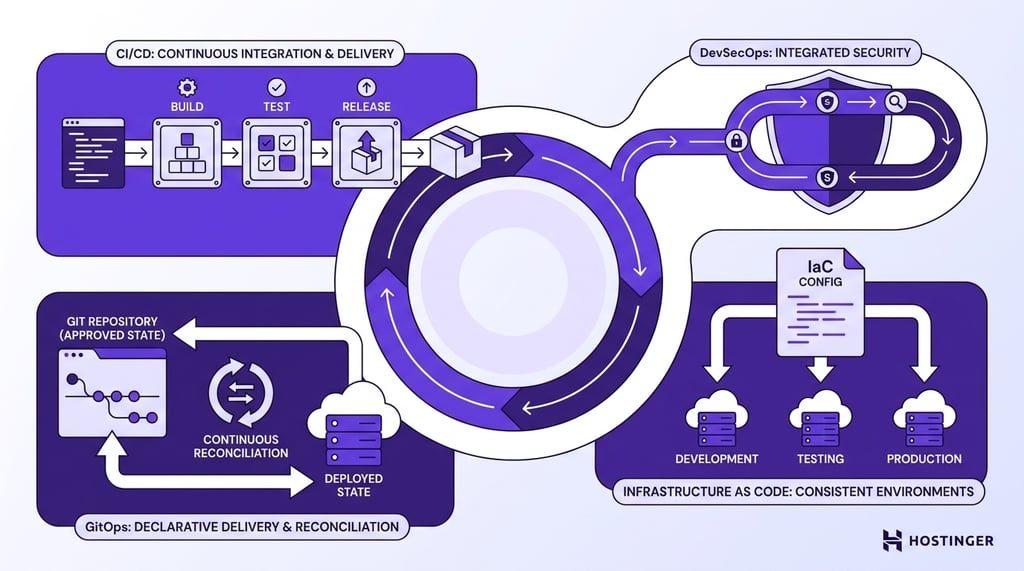
Modern DevOps relies on a set of engineering practices that automate software delivery, improve collaboration, and maintain software quality throughout the development lifecycle.
CI/CD
Continuous integration and continuous delivery (CI/CD) is a software development practice that automates the process of building, testing, and releasing applications.
Continuous integration (CI) automatically builds applications and runs tests whenever developers commit new code, ensuring changes work correctly before they are merged.
Continuous delivery (CD) prepares validated code for release, while continuous deployment automatically publishes approved changes to production without manual intervention.
Automated pipelines reduce repetitive work, identify issues earlier, and allow teams to deliver software more quickly and consistently.
Infrastructure as code (IaC)
Infrastructure as code (IaC) is a practice that manages servers, networks, databases, and other infrastructure through version-controlled configuration files.
Developers define infrastructure in code rather than configuring systems manually, enabling teams to create identical environments across development, testing, and production.
Version control also makes infrastructure changes easier to review, track, and roll back when necessary.
DevSecOps
DevSecOps extends DevOps by making security a shared responsibility across development, operations, and security teams.
Automated security testing runs alongside code builds, application tests, and deployments, allowing teams to identify vulnerabilities early and address them before software reaches production.
Security becomes part of the delivery workflow instead of a separate approval process.
GitOps
GitOps is an operational framework that manages application and infrastructure configurations through Git repositories.
Automated systems compare deployed environments with the approved configuration stored in Git and apply updates when differences are detected.
Every change is tracked in version control, providing teams with a clear audit trail and helping keep environments consistent.
Infrastructure and deployment technologies
Modern DevOps uses cloud infrastructure and container technologies to create consistent environments, automate deployments, and scale applications efficiently.
Cloud-native platforms
Cloud-native platforms provide the infrastructure that supports modern DevOps workflows.
Cloud providers give teams on-demand access to computing, storage, networking, and managed services through APIs, allowing infrastructure to be created, updated, and scaled automatically.
Automation integrates directly with CI/CD pipelines, infrastructure as code, and container orchestration, enabling teams to deliver software faster while maintaining consistency across development, testing, and production environments.
Containers
Containers are lightweight packages that include an application and everything it needs to run, including libraries, dependencies, and runtime settings.
Every environment runs the same container, reducing configuration differences between development, testing, and production. Modern DevOps teams use containers to build, test, and deploy applications with predictable results.
Kubernetes
Kubernetes is a container orchestration platform that automates the deployment, scaling, networking, and recovery of containerized applications.
Using Kubernetes, DevOps teams manage applications running across multiple servers, automatically replace failed containers, and distribute workloads as demand changes.
Automation reduces operational overhead and helps maintain application availability during deployments and failures.
Operations and continuous improvement
Modern DevOps extends beyond deployment. Continuous monitoring and controlled software releases help teams maintain reliability and improve applications over time.
Monitoring and observability
Monitoring and observability are operational practices that help teams understand how applications perform after deployment.
Teams use monitoring tools to collect predefined metrics and receive alerts when systems exceed performance or availability thresholds.
Observability combines metrics, logs, and traces to help engineers investigate failures, identify their root cause, and understand how applications behave in production.
Continuous insight allows teams to resolve incidents faster and improve future releases.
Progressive delivery
Progressive delivery is a deployment strategy that releases software to users in controlled stages.
Techniques such as feature flags, canary deployments, blue-green deployments, and automated rollbacks allow teams to validate new features with a limited audience before expanding the rollout.
Gradual deployments reduce the impact of failed releases and give teams time to detect and resolve issues before they affect all users.
Common modern DevOps tools
Modern DevOps relies on a collection of specialized tools that support different stages of the software delivery lifecycle.
No single platform covers every DevOps practice. Organizations combine tools for source control, automation, infrastructure management, monitoring, and collaboration to create workflows that match their technical requirements and development processes.
Source control
Source control systems track code changes, maintain version history, and coordinate collaboration between developers.
Git-based platforms such as GitHub, GitLab, and Bitbucket allow teams to work on separate branches, review code through pull requests or merge requests, and merge approved changes into a shared repository.
Source control also provides the foundation for CI/CD pipelines, infrastructure as code, and GitOps workflows.
Continuous integration and continuous delivery
CI/CD platforms automate software builds, testing, and deployments whenever developers commit code.
GitHub Actions integrates automation directly into GitHub repositories, making it a natural choice for GitHub users.
GitLab CI/CD combines source control and pipeline automation in a single platform, while Jenkins provides an open-source automation server with thousands of plugins for integrating development, testing, and deployment tools.
Organizations choose between integrated and standalone platforms based on their existing workflows and customization requirements.
Containers
Container platforms package applications together with their dependencies, creating consistent environments across development, testing, and production.
Docker is the most widely used platform for building and running containers. As applications grow, Kubernetes automates container deployment, scaling, networking, load balancing, and recovery across clusters of servers.
Docker and Kubernetes frequently work together, with Docker creating container images and Kubernetes managing them in production.
Infrastructure as code
Infrastructure as code (IaC) tools automate the creation and management of infrastructure through configuration files.
Terraform provisions cloud resources across providers such as AWS, Microsoft Azure, and Google Cloud using declarative configuration files.
Ansible focuses on configuration management, software installation, and application deployment through reusable automation playbooks.
Many organizations use Terraform to provision infrastructure and Ansible to configure the systems running on that infrastructure.
Monitoring and observability
Monitoring and observability tools help teams detect issues, measure application performance, and investigate failures after deployment.
Prometheus collects and stores time-series metrics from applications and infrastructure.
Grafana visualizes those metrics through customizable dashboards and alerts, making performance trends easier to understand.
Datadog combines infrastructure monitoring, application performance monitoring, log management, and security monitoring into a single cloud platform for centralized observability.
Best practices for adopting modern DevOps
Successful DevOps adoption depends on improving workflows, collaboration, and automation.
Practices that support a successful DevOps adoption:
- Automating repetitive tasks first. Automating builds, testing, deployments, and environment provisioning reduces manual work and creates consistent workflows.
- Building continuous integration before expanding into CI/CD. A reliable CI pipeline provides the foundation for continuous delivery and deployment.
- Managing infrastructure as code. Version-controlled infrastructure configurations improve consistency, simplify recovery, and reduce configuration drift.
- Integrating security throughout development. Automated security testing and policy enforcement help identify vulnerabilities before deployment.
- Monitoring applications continuously. Production metrics, logs, traces, and alerts provide the feedback needed to detect issues and improve future releases.
- Encouraging shared ownership. Development, operations, quality assurance, and security teams should work toward shared delivery and operational goals.
Putting DevOps best practices into action also requires infrastructure that supports automation, containers, and day-to-day server management.
Hostinger’s AI-managed VPS provides a practical foundation for modern DevOps workflows with full root access, a public API for automating infrastructure tasks, and one-click deployment for Docker and other development stacks.
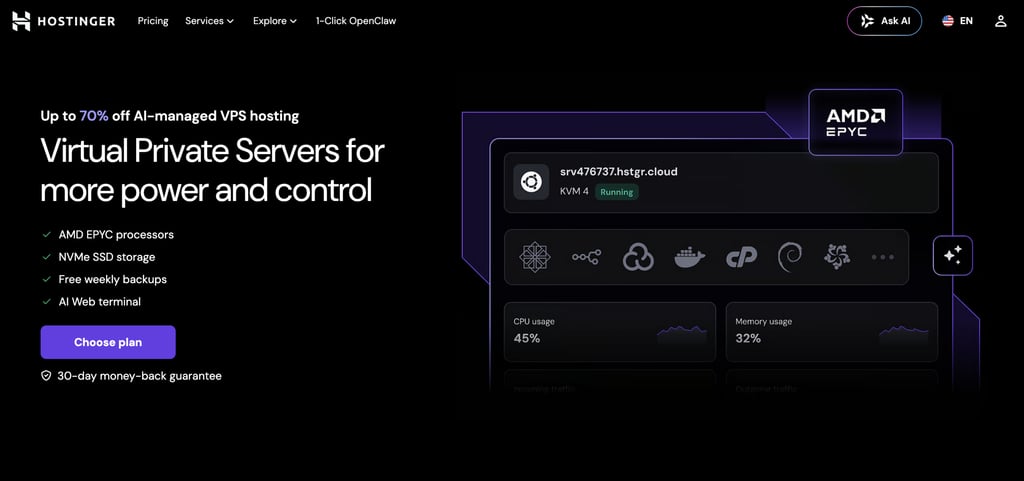
Built-in features such as an AI Web Terminal, Docker Compose Manager, firewall management, automatic weekly backups, and server monitoring help teams manage deployments and maintain infrastructure without relying on multiple separate tools.

Measuring DevOps success
Organizations measure DevOps performance with the DORA metrics, a set of four indicators that evaluate both software delivery speed and operational stability.
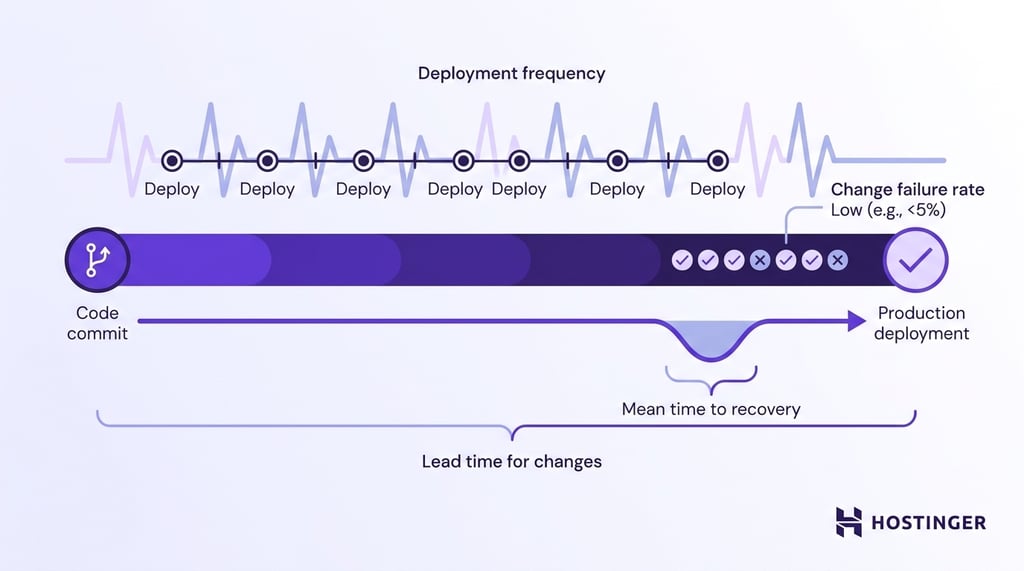
Together, these metrics help teams identify bottlenecks, improve deployment processes, and track the impact of DevOps practices over time.
- Deployment frequency measures how often teams deploy software to production. Frequent deployments indicate that development and release processes support continuous delivery.
- Lead time for changes measures how long it takes for a code change to move from commit to production. Short lead times allow teams to deliver new features and bug fixes more quickly.
- Change failure rate measures the percentage of deployments that cause service disruptions, bugs, or require remediation. A lower failure rate reflects more reliable testing and deployment processes.
- Mean time to recovery (MTTR) measures how quickly teams restore service after an incident or failed deployment. Faster recovery reduces downtime and limits the impact of production issues on users.
The future of modern DevOps
Modern DevOps continues to evolve as automation, artificial intelligence, and cloud technologies reduce manual work across the software delivery lifecycle.
Future DevOps practices focus less on managing infrastructure and more on improving developer productivity, software reliability, and operational efficiency.
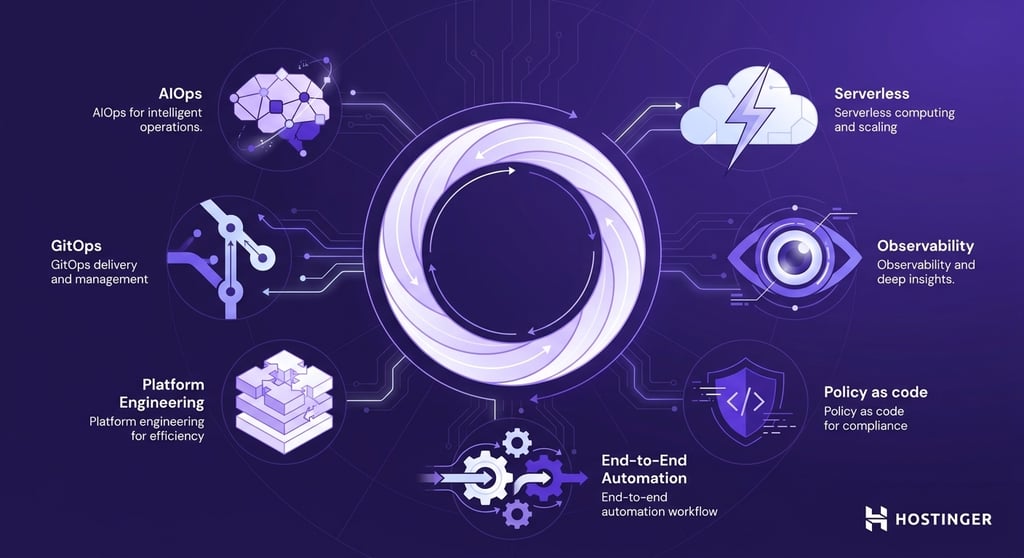
Several trends are shaping the next generation of DevOps:
- AI-assisted operations (AIOps) use artificial intelligence to analyze operational data, detect anomalies, identify the root cause of incidents, and automate routine operational tasks. This trend in software development allows developers to generate code, review pull requests, and identify potential issues before deployment.
- GitOps continues to expand infrastructure automation by using Git repositories as the authoritative source for application and infrastructure configurations. Automated synchronization reduces configuration drift and creates more predictable deployments.
- Platform engineering provides developers with self-service infrastructure, standardized deployment workflows, and reusable development environments through internal developer platforms. Development teams spend less time managing infrastructure and more time building applications.
- Serverless computing shifts infrastructure management to cloud providers, allowing developers to deploy applications without managing servers. Event-driven applications, APIs, and background services benefit from automatic scaling and reduced operational overhead.
- Observability continues to replace traditional monitoring by combining metrics, logs, and traces into a single view of application behavior. Rich operational data supports faster troubleshooting and enables automation based on real-time system health.
- Policy as code automates security, compliance, and governance by enforcing organizational policies through code. Automated policy checks ensure infrastructure and deployments follow predefined standards without manual reviews.
- End-to-end automation continues to reduce manual intervention across planning, testing, deployments, infrastructure management, security, and operations. Automated workflows improve consistency while allowing teams to deliver software more frequently.

Ksenija is a digital marketing enthusiast with extensive expertise in content creation and website optimization. Specializing in WordPress, she enjoys writing about the platform’s nuances, from design to functionality, and sharing her insights with others. When she’s not perfecting her trade, you’ll find her on the local basketball court or at home enjoying a crime story. Follow her on LinkedIn.