How to choose a domain name
May 22, 2026
/
Jordana A. & Klaudijus J.
/
8 min Read
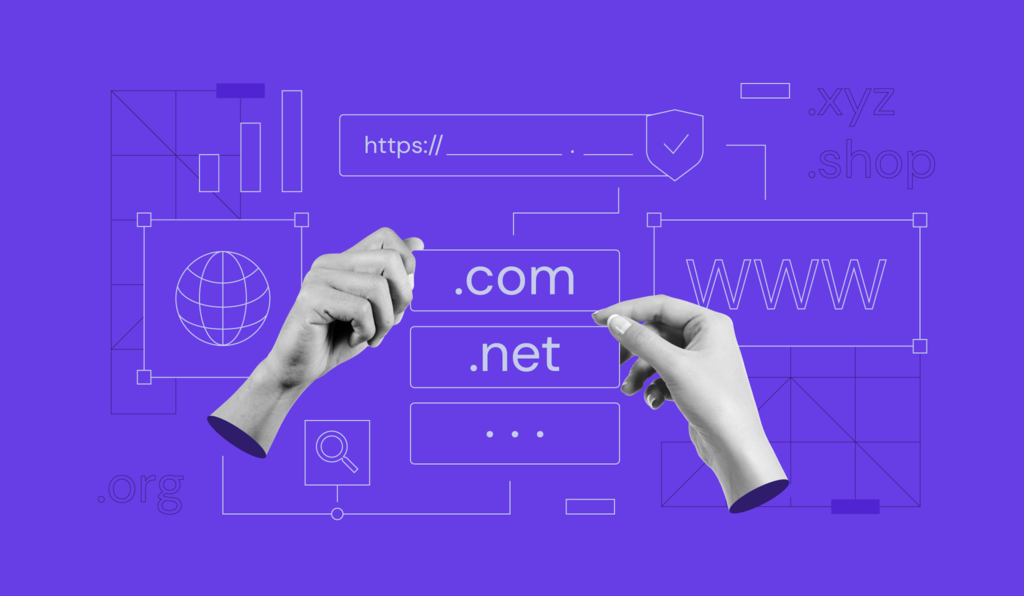
A domain name is your website’s unique URL and the address people use to find you online. When choosing a domain name, make sure it’s easy to recognize and remember, as it’s a core part of your brand that shapes your website’s first impression.
Many people struggle to come up with a domain name because the best options are often already taken, while others sound good but aren’t relevant to their brands or sound awkward when spoken aloud.
To choose a strong domain name that works for your audience, your goals, and long-term growth, you need to:
- Define your brand direction by identifying your niche, audience, and purpose so your domain reflects what your website is about.
- Choose words that are clear, short, and easy to spell to make your domain easy to remember, type, and share.
- Avoid double letters, numbers, and hyphens to reduce confusion and typing errors.
- Choose the right domain extension based on trust, availability, and your target audience.
- Consider SEO without over-optimizing by using keywords naturally in your domain.
- Research trademarks and legal issues to avoid brand conflicts and future rebranding.
- Think long-term and plan for growth so your domain still makes sense as your site evolves.
- Check the availability of your chosen name on social media to maintain consistent branding across platforms.
- Check the domain’s history to avoid inheriting spam, penalties, or security issues.
- Purchase the domain in advance to secure your brand and prevent competitors from claiming your chosen name.
By following these best practices, you’ll be able to choose a domain name that supports your brand, builds trust, and stays relevant as your website grows.
1. Start with your brand
Your domain name should clearly connect to your brand, as it shapes how people first perceive your website.
A personal portfolio, a local service, and a scalable startup will naturally call for very different domain styles.
Before brainstorming ideas, define your site’s goal, target audience, and brand personality. Getting this clarity upfront prevents mismatched or limiting choices.
Most domain names fall into two categories: brandable or descriptive.
Brandable names use unique or invented words and are ideal if you plan to grow beyond one product, service, or location. Descriptive names, on the other hand, communicate exactly what you do and work well for niche or local websites.
If your preferred name isn’t available, try a different top-level domain (TLD) or pair your brand name with a simple modifier.
See our guide on building a brand to create the foundation for your long-term online identity.
2. Keep the domain name short and simple
The simpler the domain name, the easier it becomes for people to remember, type, and share through word of mouth.
Compare gourmetbites.com with something more complex, like thegourmetbiteexperiencehub.com.
The first is easy to recall and say out loud, while the second is harder to type and more likely to be mistyped. When in doubt, clarity always wins over creativity.
Keep these tips in mind to make your domain name memorable:
- Aim for under 15 characters when possible
- Use common and easy-to-spell words
- Stick to one or two words that fit your niche
- Avoid hyphens, numbers, and forced spellings
- Say it out loud to check how it sounds and flows
If you’re stuck, use the best domain name generators to help you come up with different ideas.
3. Avoid using double letters, numbers, and hyphens
Adding numbers, hyphens, or double letters may seem like an easy workaround when your preferred domain isn’t available, but these elements often create confusion and reduce trust.
The same applies to numerals. Domains with spelled-out numbers are easier to remember and explain than those using digits, especially in word-of-mouth situations.
While numerals can work in some cases, they tend to look less professional and are more likely to be misinterpreted when shared verbally.
Moreover, avoid double letters unless they’re really meaningful to your brand name. Double letters often cause typing errors, which can send users to the wrong site or trigger browser warnings – both of which can hurt traffic and credibility.
Well-known brands can sometimes get away with unusual spellings or symbols because people already recognize them. For most websites, simplicity still wins.
Before committing, test your domain name with real people and pay attention to how often they misspell, mishear, or hesitate. If they stumble, your audience most likely will, too.
4. Choose the right domain extension
A top-level domain (TLD) is the ending of a domain name, such as .com, .net, or .org. While it may seem minor, your domain extension shapes first impressions and influences how trustworthy your website feels.
Traditional extensions such as .com and .net remain the most widely used because they’re easy to recognize, making them the default choice for many websites.
However, as many businesses and individuals build their online presence, domain choices have become more limited. This opened the door to newer TLDs, which now offer more creative flexibility and branding opportunities. Extensions like .online or .studio can help you secure a short, memorable name that would otherwise be unavailable.
Niche and country-specific extensions are also useful in specific situations. For example, nonprofits often use .org, and businesses targeting a local audience may choose extensions like .co.uk or .us.
While most TLDs are available to anyone, restricted extensions such as .gov and .edu are reserved for official institutions.
Browse our list of domain extensions to see the available options and compare prices. When choosing one, focus on what feels natural and trustworthy for your audience, not just what’s available.
Domain Name Checker
Instantly check domain name availability.
5. Consider SEO without over-optimizing
A domain name doesn’t directly improve search rankings, but it can support search engine optimization (SEO) by reinforcing relevance and clarity.
Besides being readable and memorable, an SEO-friendly domain name includes keywords relevant to your brand’s niche. Keywords give visitors context about your website and boost your pages’ rankings for relevant search queries.
Let’s say you want to start a travel blog. Incorporating keywords such as “flight” and “tourism” helps visitors understand your website’s purpose. You can also experiment with niche keywords like “surf” and “beach” to further narrow your target audience.
Stuck on keyword ideas? Watch how an AI-based generator can instantly turn your brand keywords into smart domain name suggestions:


Avoid keyword stuffing or awkward exact-match domains that read like search queries. Names packed with multiple keywords may look spammy, feel less trustworthy, and limit your brand’s ability to grow beyond a narrow topic.
Keyword research tools like Keyword Planner can help you understand how people search and identify terms worth considering. And once your site is live, don’t forget to submit your website to search engines, as it’s the key step to make your site indexed properly.
6. Research trademarks and legal issues
Before finalizing your domain name choice, check that it isn’t trademarked or too similar to an existing brand. This helps you avoid legal disputes, forced rebranding, or customer confusion.
Do note that even if a name isn’t an exact match, similar brand names can still cause conflicts.
Variations in spelling, plural forms, or slight wording changes may still be considered infringing if they’re likely to confuse customers. This is particularly risky when businesses operate in the same market or target a similar audience.
To reduce these risks, do basic trademark research before committing to a domain name:
- Search official databases such as national trademark registries, WIPO, or the US Trademark Electronic Search System (TESS).
- Look beyond exact matches and check for similar-sounding or visually similar names.
- Search Google and social platforms to see how the name is already being used.
If your preferred name raises concerns, consider small adjustments, such as adding a brand modifier or adapting it for your target audience’s language.
For long-term protection, learning how to trademark a business name early or consulting a legal professional can help you move forward with confidence.
7. Think long-term and plan for growth
Your domain name should still make sense years from now. A name that feels too specific today can quickly become a limitation as your website evolves.
Avoid tying your domain too closely to a single location, product, or trend. Location-based names can make regional expansion awkward, while trendy terms often age poorly, leaving an established brand to feel outdated.
Instead, choose a domain that leaves room for growth. A flexible name allows you to introduce new products, expand services, or reach new audiences without confusing existing users or forcing a rebrand.
Understanding why you need a domain name from the start helps you choose one that supports long-term scalability, cultural relevance, and adaptability as your business grows.
8. Check availability on social media
Consistent naming helps visitors know they’re engaging with the same brand, whether they’re on your website or social channels.
That’s why it’s essential to check if your domain name options are available as usernames on popular social networks.
Tools like DNS Checker let you see if a name is free across dozens of social platforms and domains at once, saving you the time of checking each site individually.
In case your preferred handle isn’t available, you can try simple variations that still feel cohesive with your domain. For instance, you can add a short word like official, hq, or co, but avoid overly complex additions.
9. Check the domain’s history
Buying a previously used domain without checking its history can harm your brand and SEO if it was once associated with spam, malware, or low-quality content.
Search engines may still see lingering backlinks or reputation issues, which can slow your rankings and make it harder to build user trust.
Looking into a domain’s history helps you avoid inheriting hidden problems and ensures your new website starts with a reputable foundation.
To make sure you’re starting with a clean slate, investigate a domain’s past before you register it:
- Use the Wayback Machine (Internet Archive) to view old snapshots and see what content was hosted there.
- Run an ICANN lookup check to see past ownership, frequent transfers, and other registration details.
- Examine backlink profiles with tools like Ahrefs, Moz, or SEMrush to spot spammy links or irrelevant sources.
- Check security and blacklist status with tools like Google Safe Browsing or Spamhaus to detect past malware or phishing activity.
10. Purchase the domain in advance
Once you find a domain name that fits your brand, it’s best to register it right away. Domain names are claimed continuously, and waiting too long increases the risk that someone else will register your preferred option.
If you’re not ready to launch, you can park the domain. Domain parking lets you secure ownership while temporarily displaying a placeholder page or keeping the domain inactive until your site is live. This allows you to protect your brand name early without rushing into development.
Many registrars also offer limited-time discounts, especially on certain TLDs, making early registration more cost-effective.
If your budget allows, registering your domain for multiple years upfront can help lock in lower pricing, reduce renewal overhead, and avoid future price increases or accidental expiration.
How to choose the best domain registrar
When searching for the best domain registrar, pay attention to the following factors:
- Registration period. Look for registrars that offer discounts for multi-year registrations. This can lower long-term costs and reduce the risk of forgetting to renew.
- Domain transfer flexibility. Choose a registrar with clear, hassle-free transfer policies so you’re not locked in if your needs change.
- Overall value for money. Some registrars offer free add-ons such as WHOIS privacy protection, domain forwarding, or DNS management, which would otherwise cost extra.
- Domain extension variety. A wide selection of TLDs gives you more creative freedom if your first choice isn’t available.
- Customer support quality. Reliable, responsive support is essential when dealing with renewals, transfers, or DNS issues.
- Ease of use. A clean, intuitive control panel makes it much easier to manage settings, park domains, or connect services without technical friction.
- Renewal safeguards. Auto-renewal and expiration reminders help prevent accidental domain loss, which can be costly and difficult to recover from.
How do you register your chosen domain name?
Choosing the right domain name strengthens your brand identity, improves search visibility, and increases user trust. A clear, short, and relevant business domain name helps visitors recognize your business instantly and makes your website easier to remember.
Once you’ve selected a domain name, the next step is to buy and register your domain name and connect it to reliable web hosting. A domain name allows users to find your website, while hosting stores your website files and makes them accessible online. Registering your domain for multiple years protects your brand and prevents accidental expiration.
After registration, configure your DNS settings and activate an SSL certificate to secure your website. Security signals such as HTTPS improve user trust and contribute to better search performance.
If you’re launching a new project, you can immediately connect your domain to a website builder or CMS platform to start publishing content. For example, you can create a business website, an online store, or a personal portfolio under your new domain.
Your domain name is the foundation of your online presence. The stronger and more relevant it is, the easier it becomes to grow traffic, build authority, and scale your brand in the long term.

Jordana is a Senior Content Writer with a background in Information Systems. She has over five years of experience in WordPress and is casually dabbling with PHP and MySQL. Her passion for writing and technology drives her to create tutorials for anyone wanting to build their online presence. Follow her on LinkedIn.

As Hostinger's Head of Domains, Klaudijus Januitis is a product leader but also a customer advocate ensuring the product meets user needs. He works closely with engineering, design, and marketing teams to develop and adapt the product and ensure alignment between product strategy and company goals. Klaudijus is also skilled in building relationships with registries and resellers to support joint marketing efforts and ensure successful partnerships. Follow him on LinkedIn.