AI in ecommerce: Benefits, use cases, and what’s next
Mar 09, 2026
/
Simon L. & Auksė Å.
/
9 min Read

AI in ecommerce refers to the use of artificial intelligence, machine learning, and data analytics to personalize shopping experiences, automate customer service, and optimize online store operations. Ecommerce businesses use AI tools to recommend products, power intelligent search, manage inventory, and support shoppers through AI chatbots.
AI now influences nearly every stage of the ecommerce customer journey, from product discovery and personalized recommendations to checkout optimization and order fulfillment.
The most common applications include:
- Personalized shopping recommendations. AI uses browsing behavior and purchase history to surface products that customers actually want.
- Predictive analytics for inventory. Machine learning forecasts demand spikes, seasonality, and returns so you can avoid stockouts and reduce dead stock.
- AI chatbots for customer support. Virtual agents handle FAQs, returns, and delivery tracking 24/7 across time zones, cutting response times and reducing churn.
- Generative AI for product content. AI tools produce SEO-optimized descriptions, meta titles, and category copy at scale.
- Fraud prevention. AI flags suspicious transactions in real time using anomaly detection, reducing fraud losses.
- Smart search functions. Voice and visual search let customers find products by speaking or uploading images, reducing friction and boosting conversions.
What are the benefits of using AI in ecommerce?
The benefits of using AI in ecommerce come down to four things: more revenue, lower costs, better retention, and smarter inventory management. Here’s how each one plays out.
Boost revenue through hyper-personalized recommendations
Personalization is the most directly profitable application of AI in ecommerce.
Recommendation engines like Algolia, Amazon Personalize, and Dynamic Yield analyze what people browse, what they buy, and what they do in real time to surface products that actually match each visitor’s interests.
When your store can do that consistently, people spend more, buy more often, and stick around longer.
If you’re looking to enhance your ecommerce customer experience, this is one of the highest-impact places to start.
Product recommendations alone can account for up to 31% of ecommerce revenue in sessions where shoppers actively engage with them, per Barilliance data.
These aren’t just surface-level gains. Personalization improves average order value (AOV) by delivering recommendations that are actually relevant, leading to more items per cart, better upsell performance, and fewer bounces.
Improve customer retention with 24/7 AI support
One frustrated customer who can’t get a quick answer about a return or a delayed shipment can easily become an ex-customer.
That’s why AI-powered chatbots have become so valuable for ecommerce businesses. They respond instantly, work across time zones, and handle the repetitive questions that would otherwise bury your support team.
For post-purchase issues especially, where speed and convenience determine whether someone comes back, AI support can be the difference between a one-time buyer and a loyal customer.
When your support system remembers a customer’s order history, resolves issues on the first interaction, and works at 2 AM without a wait queue, that consistency compounds. You spend less on acquiring new customers because the ones you already have keep coming back.
Optimize inventory and reduce stockouts
Running out of a bestselling product during a demand spike is one of the most expensive mistakes in ecommerce. On the flip side, overstocking ties up cash and fills warehouses with products that may never sell.
AI-powered tools solve both problems by analyzing seasonality, customer behavior patterns, and external signals such as weather and local events to predict what you’ll need and when.
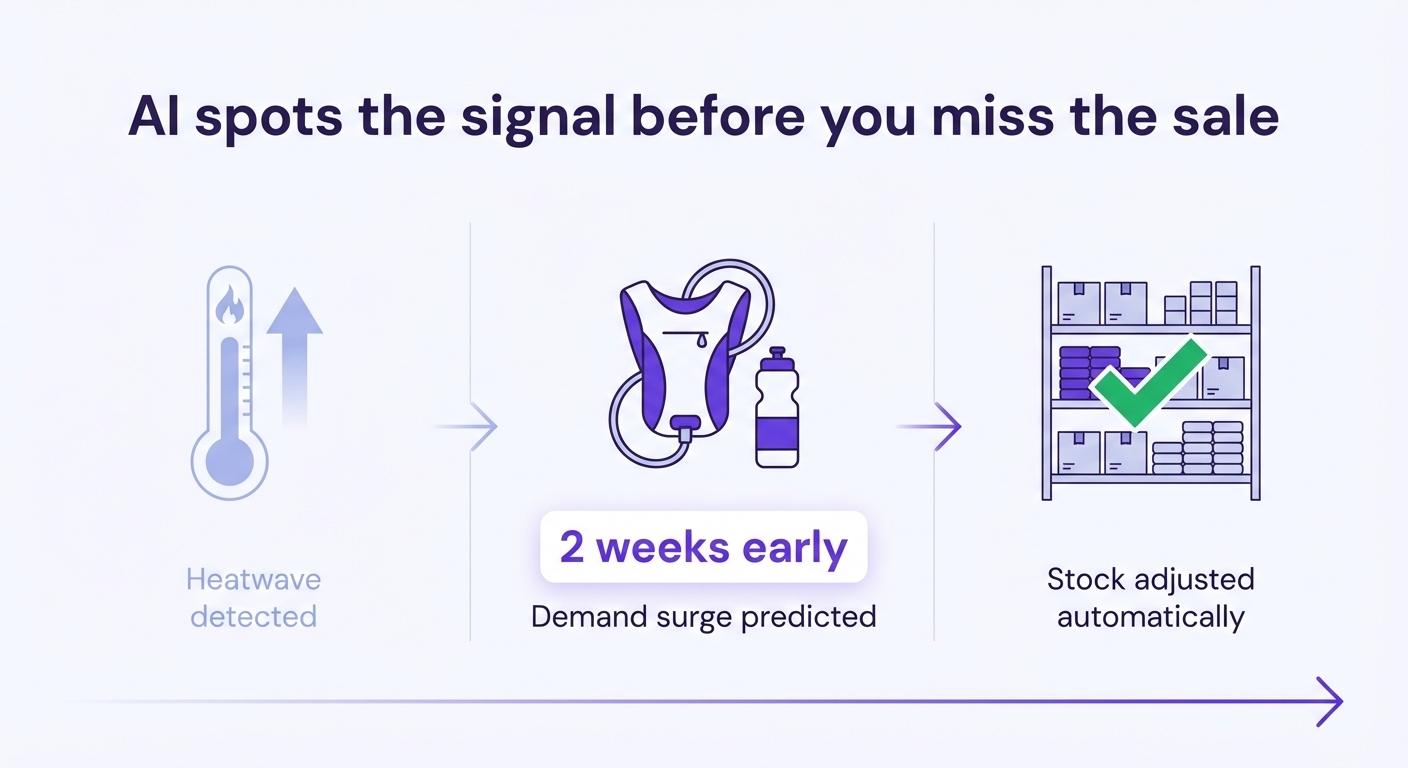
The impact is substantial. For example, a store selling outdoor gear could use AI to detect that a local heatwave is driving demand for hydration packs two weeks earlier than usual, automatically adjusting reorder quantities before the stockout happens.
Without AI, that insight shows up in a sales report after you’ve already missed the window.
Lower operational costs through automation
AI doesn’t just make more money. It saves money, too. Tasks like writing product descriptions, sending email campaigns, updating inventory, and detecting fraud can all be partially or fully automated with AI tools.
The cost savings are adding up. According to a Statista survey on AI adoption in retail, 94% of AI-adopting retailers say they’ve seen decreased operational costs through more efficient inventory management, automated customer service, and data-driven decision-making.
This doesn’t mean replacing your entire team with robots. It means freeing up your people to focus on creative, strategic work while AI handles the repetitive stuff.
If you’re weighing the overall case for online selling, understanding the benefits and drawbacks of ecommerce gives you a clearer picture of where AI fits in.
Common use cases of AI in ecommerce
Common use cases of AI in ecommerce span product recommendations, customer support chatbots, inventory forecasting, fraud detection, content generation, and smart search.
AI for personalized recommendations
AI enables personalized product suggestions by analyzing browsing behavior, purchase history, and real-time interactions. The core problem it solves is the “paradox of choice,” where too many options overwhelm shoppers and lead to abandoned sessions.
Under the hood, algorithms like collaborative filtering (recommending products based on what similar users bought) and deep learning models process massive datasets to surface the right products at the right moment.
Tools like Algolia, Shopify Magic, and Amazon Personalize are widely used for this.
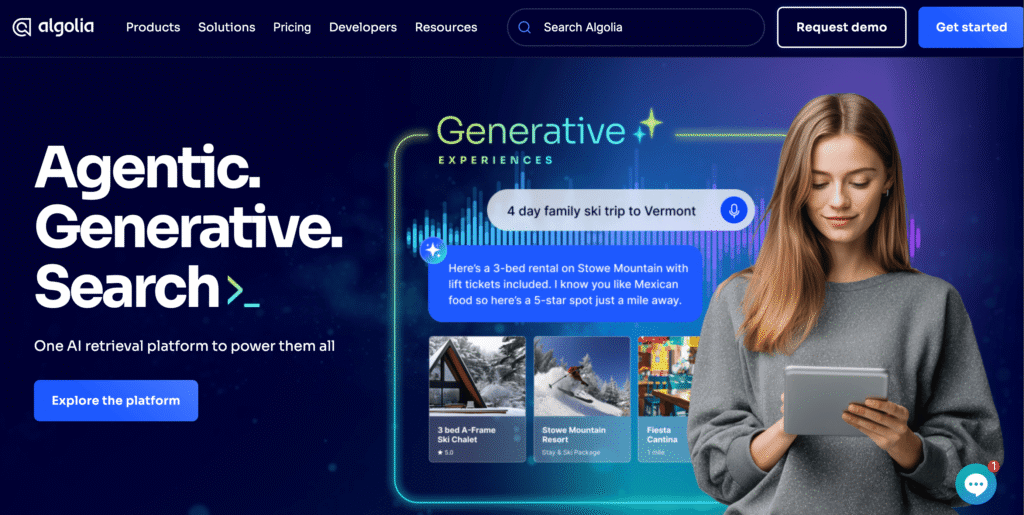
Where it shows up for shoppers is in sections like “You may also like,” “Frequently bought together,” and “Customers also bought.”
These sections aren’t decorative. They’re conversion tools. For example, Amazon reportedly attributes around 35% of its revenue to its recommendation engine.
AI chatbots and conversational agents
AI chatbots powered by natural language processing (NLP) and large language models handle customer questions, process returns, and guide users through checkout without a human agent.
The tools leading this space include Zendesk AI, ChatGPT-based plugins, and Intercom Fin. These aren’t the clunky chatbots of five years ago.
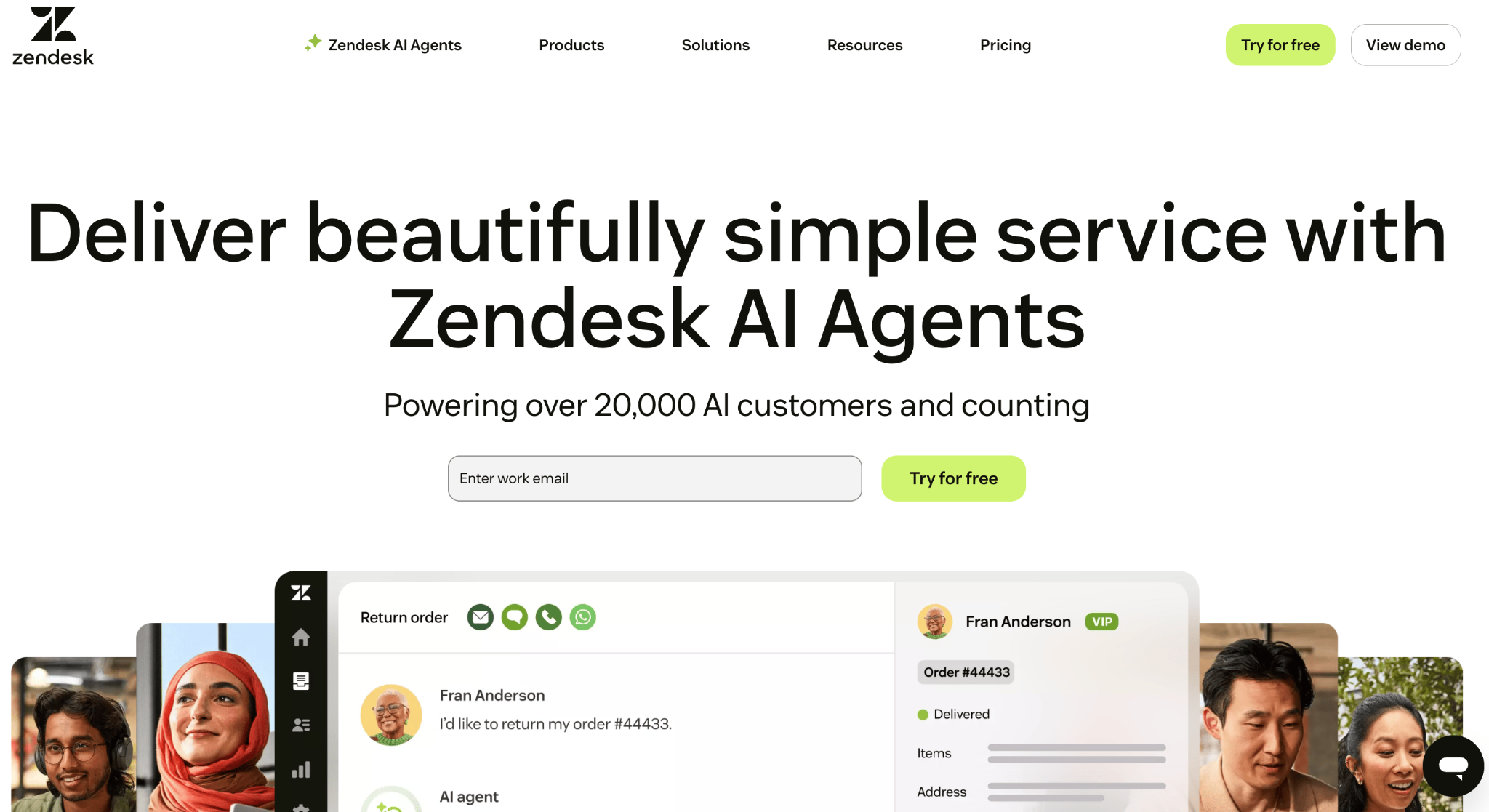
Modern conversational agents understand context, handle multi-turn conversations, and can escalate to a human when needed.
For ecommerce businesses, the key outcomes include:
- Reduced support ticket volume.
- Faster response times across every time zone.
- Increase in sales from retail chatbots.
- Potentially higher conversion rates in AI-assisted sessions.
When a chatbot can answer a sizing question or track a shipment instantly, that’s one less reason for a customer to abandon the purchase.
Predictive inventory and supply chain management
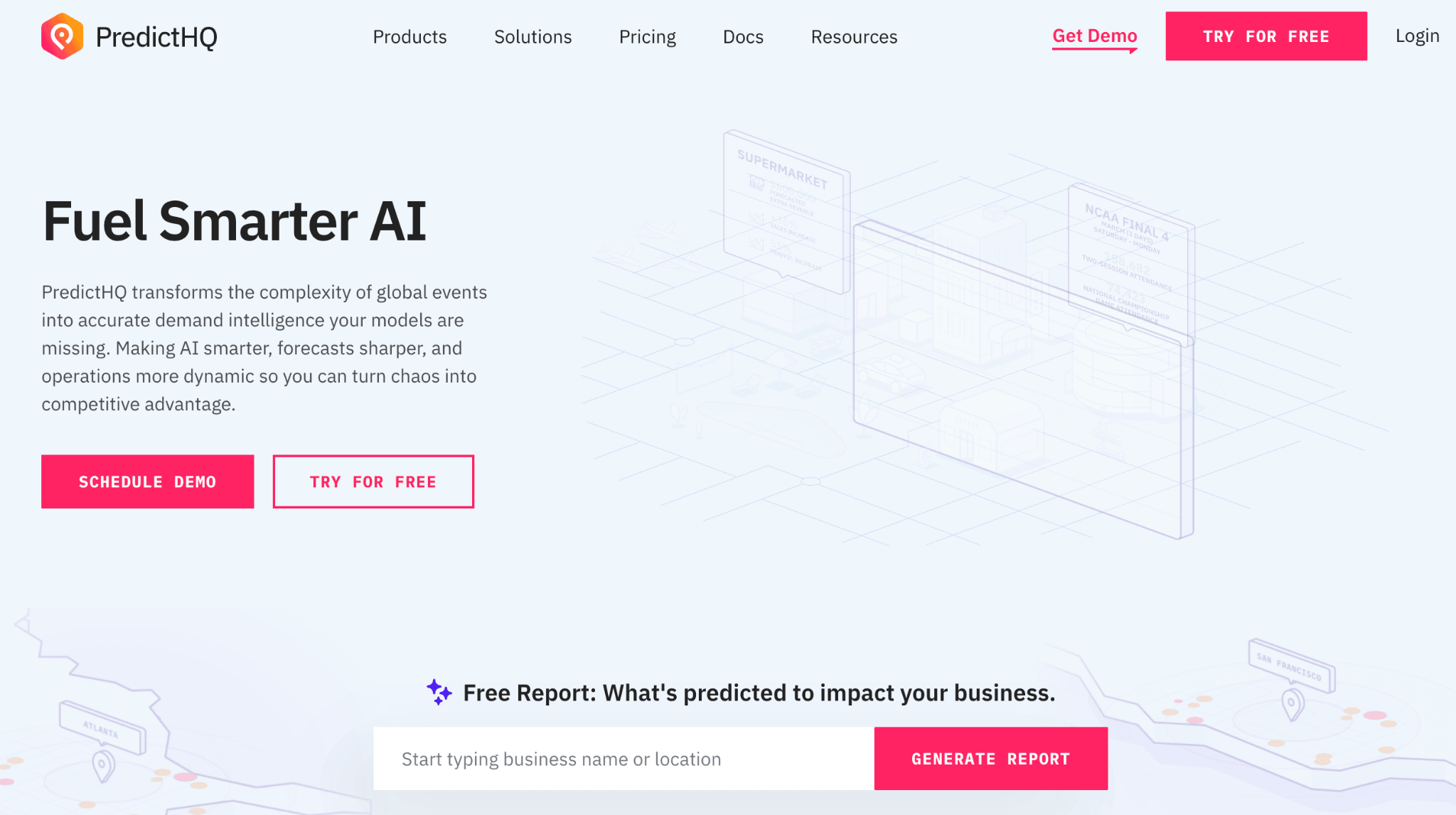
Machine learning models can forecast product demand by analyzing seasonality patterns, customer behavior, and external signals like weather, local events, or economic trends.
Tools like PredictHQ and Relex help businesses anticipate what they’ll need and when. The outcomes include fewer stockouts, lower holding costs, faster fulfillment, and less wasted inventory.
Beyond demand forecasting, AI-powered warehouse robots are also improving operational efficiency by handling picking, packing, and sorting tasks that once required massive manual labor.
Alibaba’s logistics arm, Cainiao, is a good example of this in action, using AI-driven robotics and route optimization to manage fulfillment across one of the world’s largest ecommerce ecosystems.
Fraud detection and transaction monitoring
AI systems flag suspicious behavior in real time by analyzing patterns like mismatched IP addresses, unusual purchase amounts, rapid-fire transactions, or high-risk payment methods. This is a massive upgrade over traditional rule-based systems, which are static and easily outmaneuvered by evolving fraud tactics.
Tools like Stripe Radar, Kount, and Darktrace use anomaly detection and supervised learning to spot fraudulent transactions while minimizing false positives.

This matters for both your bottom line and your reputation. Every false decline is a lost sale and a frustrated customer. Every successful fraud attempt is a chargeback and a trust issue.
AI fraud detection finds the balance between security and customer experience far better than manual rules ever could.
AI-generated content for product pages
Generative AI helps ecommerce teams produce SEO-optimized product descriptions, meta titles, category blurbs, and marketing copy at scale. If you’ve ever stared at a spreadsheet of 500 products that all need unique descriptions, you already understand why this is a game-changer.
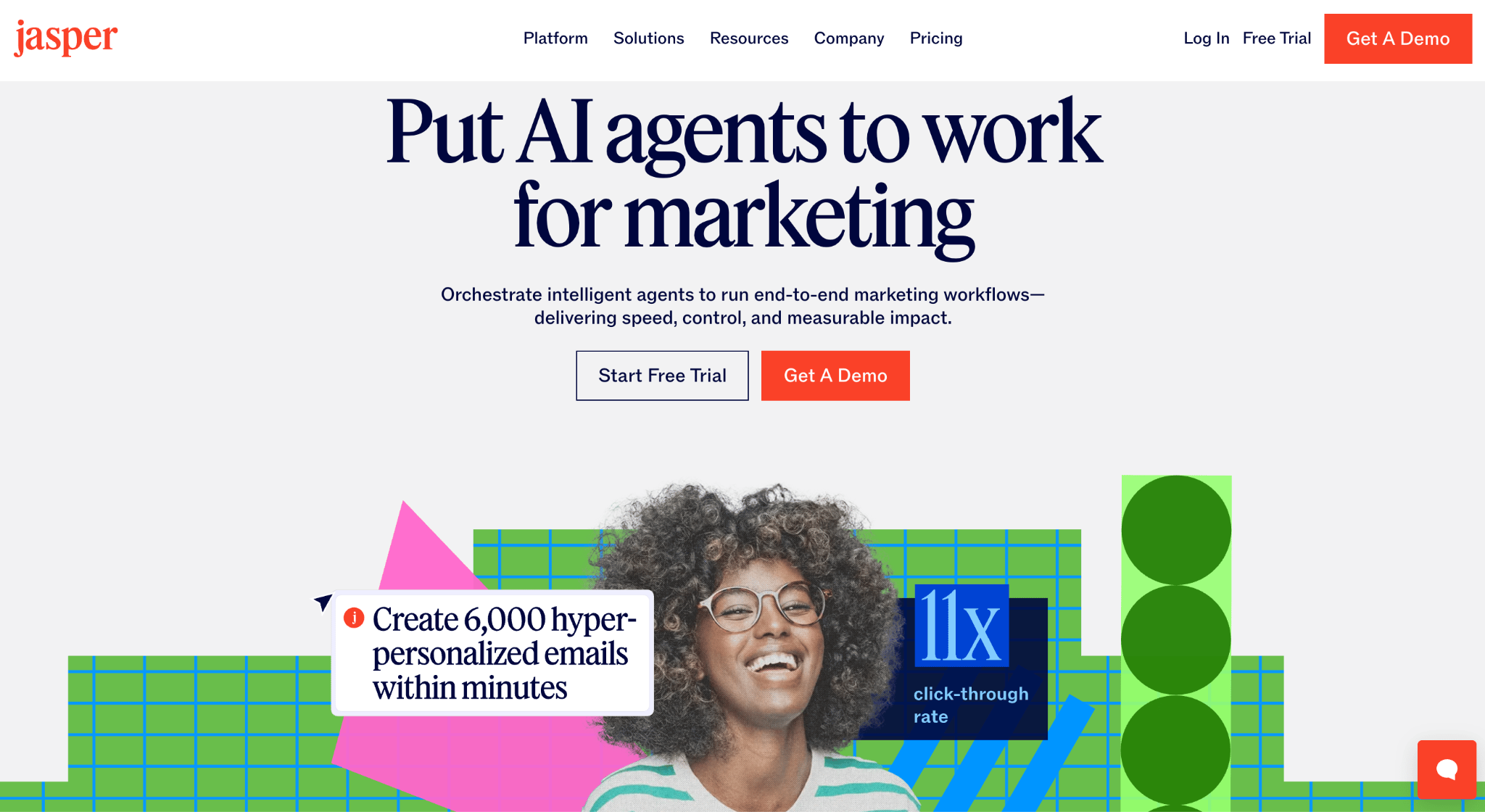
Tools like Frase, Jasper, and Hostinger’s AI Writer can draft content quickly, but AI-generated content still needs a human review.
Make sure every description is:
- Accurate and free of unsupported claims.
- Aligned with your brand voice.
- Inclusive of product-specific specs and details.
The best approach is to use AI as a first-draft machine and then refine. For a deeper dive into this process, check out our guide on writing effective product descriptions.
Voice and visual search in ecommerce
AI lets you search for products by speaking (“Hey Google, find me a red leather crossbody bag”) or by uploading an image of something you want to find. This is powered by natural language processing and computer vision technologies.
Google Lens, Pinterest Lens, and Amazon Alexa Shopping are the biggest players here. For mobile-first and Gen Z audiences especially, these search methods feel more natural than typing keywords into a search bar.

The ecommerce implications go beyond convenience. When someone can snap a photo of a product they saw on the street and immediately find it (or something similar) in your store, that’s a conversion path that didn’t exist five years ago.
Social media and email automation
AI helps ecommerce teams automate content scheduling, optimize email send times, generate subject lines, and create social media copy without the endless manual effort.
Tools like Buffer AI, FeedHive, and Flowrite can handle everything from drafting your next Instagram caption to determining exactly when your audience is most likely to open an email. The result is more consistent output and higher engagement rates without burning out your marketing team.

Where AI really shines here is in A/B testing and segment personalization. Instead of guessing which subject line will perform better, AI can test variations automatically and optimize based on results.
Personalized emails often deliver higher transaction rates than generic blasts, and AI-driven send-time optimization ensures your messages land when people are actually looking in their inboxes.
For a roundup of the best options, take a look at these top social media automation tools.
What are the challenges and limitations of using AI in ecommerce?
The biggest challenges with AI in ecommerce stem from cost, data quality, and ethical concerns. Understanding these upfront helps you plan around them instead of getting blindsided.
High implementation and infrastructure costs
Enterprise-grade AI isn’t cheap. If you’re building custom models or integrating advanced AI systems, you’ll need robust computing power (GPUs, cloud infrastructure), API access, and data pipelines.
For small and medium-sized businesses, this can feel out of reach.
Initial setup for a custom AI integration can cost $5,000 to $7,000 upfront, with ongoing monthly costs of $600 to $1,000, depending on scale.
Enterprise solutions from providers like AWS Bedrock or OpenAI’s business tier can cost significantly more.
But here’s the good news: you don’t have to build everything from scratch. Third-party SaaS integrations, open-source models, and platforms like Hostinger’s AI Website Builder offer accessible entry points that let smaller businesses tap into AI without a massive budget.
Start with one high-impact use case, measure results, and scale from there.

Data quality and dependency
AI’s output is only as good as its input. If your product data is messy, outdated, or incomplete, your AI tools will produce irrelevant recommendations, inaccurate forecasts, and frustrating customer experiences.
Imagine a recommendation engine trained on outdated browsing data suggesting winter coats to someone shopping in summer. Or a chatbot pulling from an incomplete product database and giving wrong answers. These scenarios erode trust fast.
To avoid this, focus on a few practical steps:
- Train your models on diverse and recent behavioral datasets.
- Implement routine data hygiene practices (clean up duplicates, fix categorization errors, update product attributes regularly).
- Use zero-party and first-party data wherever possible, meaning information customers voluntarily share with you, rather than relying on inferred or third-party data that may be unreliable.
For more on protecting your store and its data, review these ecommerce security best practices.
Bias, ethics, and AI transparency concerns
AI amplifies bias if it’s trained on unrepresentative data. In ecommerce, this could mean your recommendation engine consistently underserves certain customer segments, or your ad targeting excludes groups based on patterns the algorithm picked up from skewed training data.
The solution involves multiple layers:
- Implement “human-in-the-loop” oversight to ensure AI decisions aren’t run unchecked.
- Use ethical AI toolkits, such as IBM’s AI Fairness 360, to audit your models for bias.
- Add transparent disclaimers when content or recommendations are generated by AI.
- Conduct regular data audits to ensure your training data reflects the full diversity of your customer base.
Customers notice when recommendations feel off or exclusionary. Documenting how your models work, regularly testing for fairness, and being upfront about where AI is involved build the kind of trust that keeps people coming back.
AI tools and ecommerce platforms businesses should know in 2026
With so many options available, it helps to organize tools by what they actually do. Here’s a practical breakdown of the key categories and standout tools worth exploring:
Category | Tools | Best for | Pricing tier |
Content generation | Frase, Jasper, Hostinger’s AI writer | Product descriptions, meta tags, blog content at scale | Free to mid-range |
Chatbots and support | ChatGPT API, Zendesk AI, Intercom Fin | 24/7 customer service, returns processing, checkout guidance | Free tier available, scales with usage |
Inventory and supply chain | Relex, PredictHQ, Shopify AI Inventory | Demand forecasting, stockout prevention, warehouse optimization | Mid-range to enterprise |
Fraud detection | Stripe Radar, Kount, Darktrace | Transaction monitoring, anomaly detection, chargeback prevention | Usage-based pricing |
Store and app building | Hostinger Website Builder, Hostinger Horizons | AI-assisted store creation, content generation, and custom ecommerce web apps | Budget-friendly |

How top companies use AI in ecommerce
Looking at how real companies use AI makes the possibilities more concrete. Here’s how Hostinger, Amazon, Alibaba, and Shopify are each using AI to solve specific business problems.
Hostinger
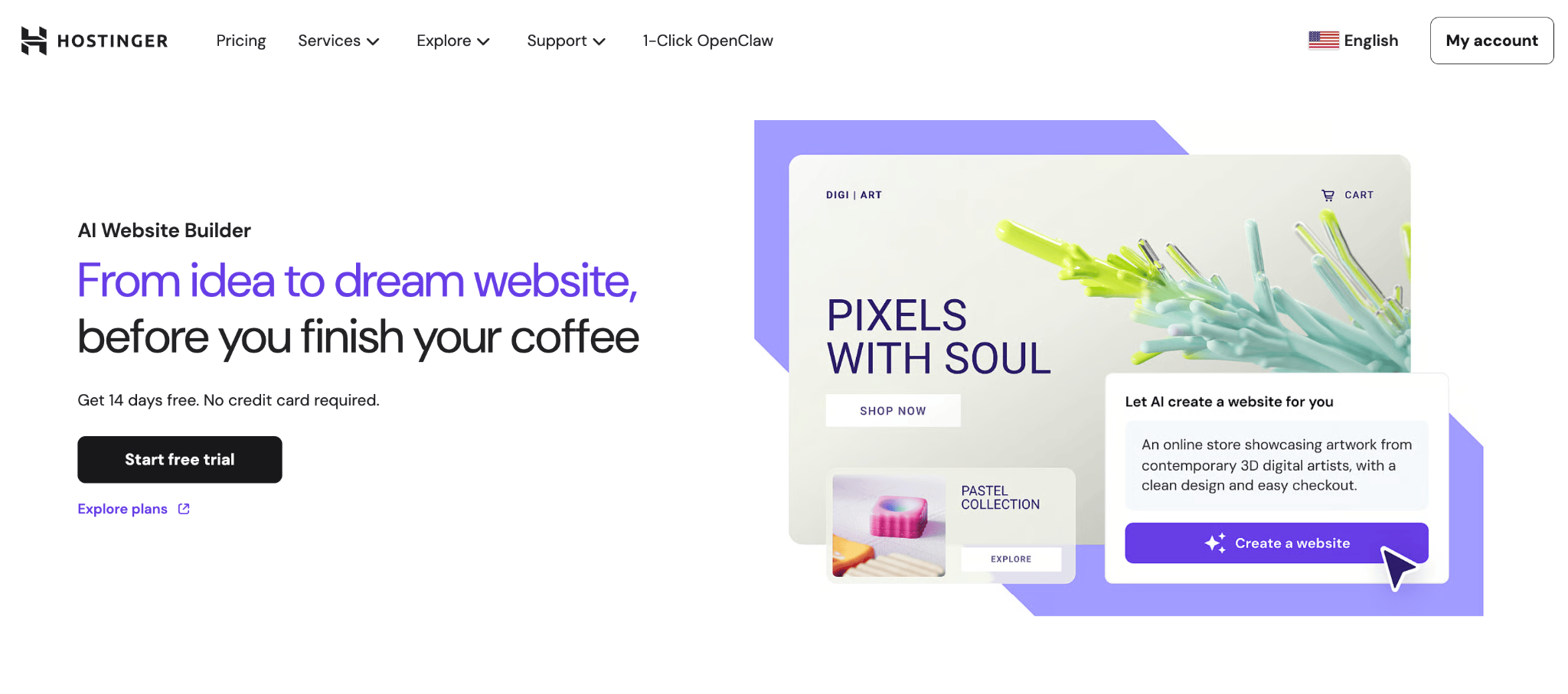
Hostinger’s Website Builder uses AI to help users create online stores quickly, even without technical skills. The AI assistant generates entire website layouts, writes product descriptions, and creates visual content.
Hostinger Horizons, its no-code AI app builder, goes a step further by letting users build custom web apps and ecommerce tools through plain-language prompts.
What stands out: Hostinger has made AI-powered ecommerce accessible at a price point that most solo entrepreneurs and small businesses can actually afford. You can go from idea to live store in an afternoon, which removes the biggest barrier most new sellers face.
Amazon
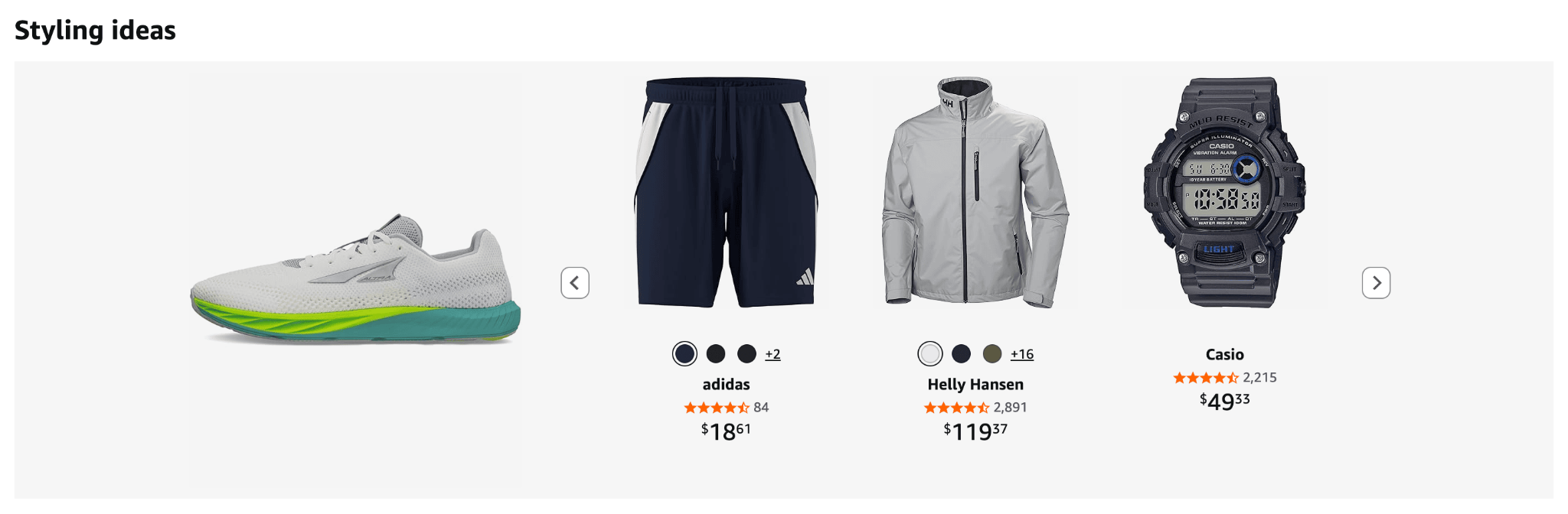
Amazon’s recommendation engine is arguably the gold standard in ecommerce AI. Its system analyzes browsing behavior, purchase history, and dozens of other signals to reveal personalized suggestions at every touchpoint.
But recommendations are just one layer. Amazon runs AI across Alexa Shopping (voice commerce), dynamic pricing that adjusts millions of prices daily, and fulfillment centers where AI-powered robots handle picking, packing, and delivery route planning.
What stands out: The real takeaway is how Amazon connects AI systems together: recommendations feed inventory planning, which feeds fulfillment, which feeds pricing. That integration is where the competitive advantage lives.
Alibaba
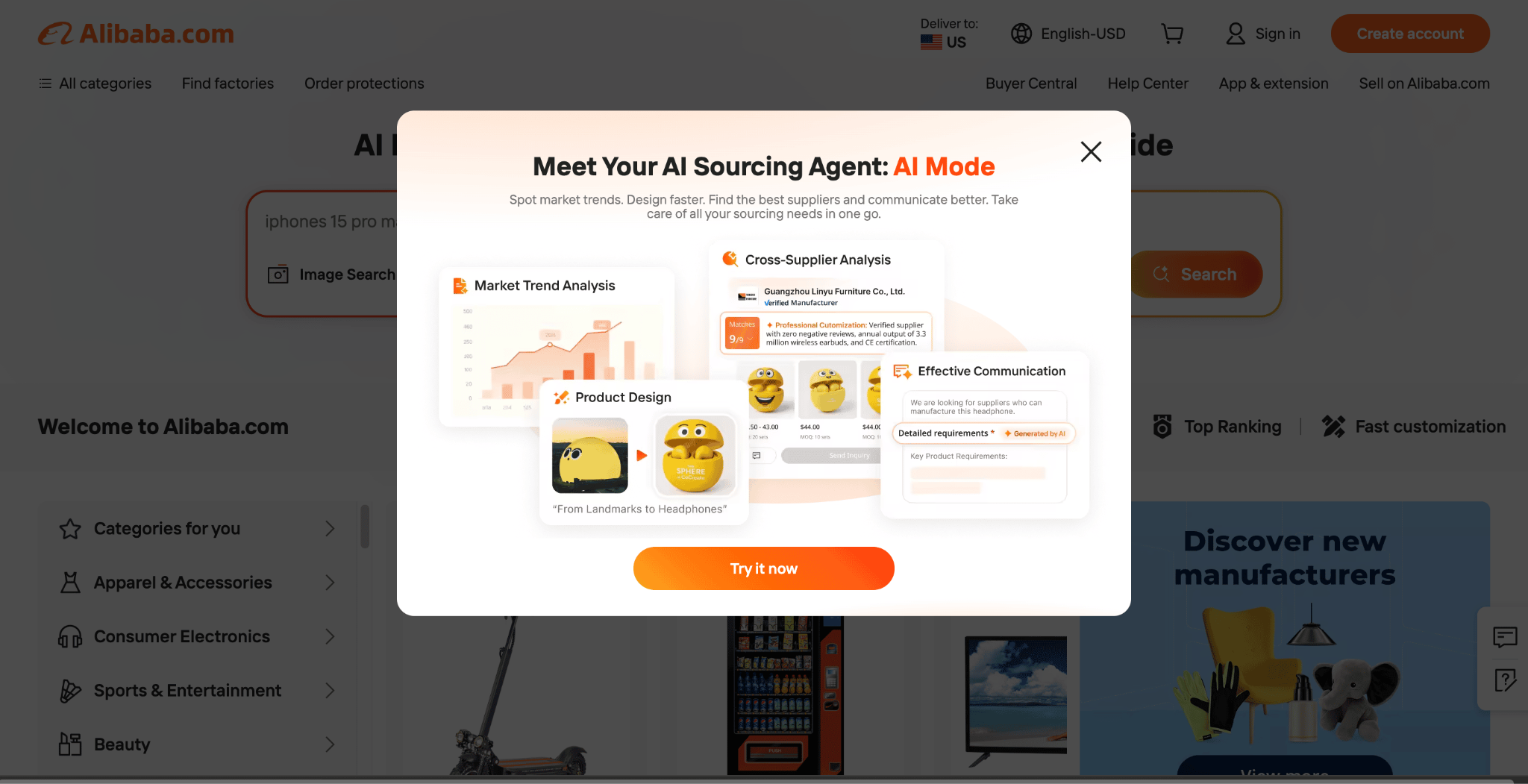
Alibaba uses AI chatbots to handle the vast majority of its customer support volume across platforms like Taobao, covering everything from order tracking to dispute resolution.
During peak events like Singles’ Day, its AI systems scale to manage enormous query volumes that would be impossible to staff with human agents alone.
What stands out: Alibaba proves AI can operate at a massive scale without sacrificing service quality. Its logistics arm, Cainiao, layers on AI-driven warehouse automation and delivery optimization, accelerating the entire ecosystem.
Shopify

Shopify has embedded AI across its platform with Shopify Magic and Sidekick. But the most significant recent move is its push into “agentic commerce,” where merchants can sell directly through AI platforms like ChatGPT, Google Gemini, and Microsoft Copilot.
Shopify handles checkout, payments, and order processing even when the purchase starts inside an AI conversation.
What stands out: For the millions of small businesses on the platform, these built-in capabilities mean they can access enterprise-level AI without extra cost or configuration.
What’s next for ecommerce AI?
AI in ecommerce isn’t slowing down. The generative AI market alone is projected to hit $1.3 trillion by 2032, and AI could contribute over $15.7 trillion to the global economy by 2030, according to our AI statistics.
These aren’t speculative numbers. They reflect real investment, real adoption, and real results.
A few trends worth watching closely include:
- Agentic AI, where AI systems independently execute multi-step tasks like reordering inventory, adjusting pricing, and orchestrating marketing campaigns.
- Multimodal assistants that combine text, voice, and visual understanding, making shopping more intuitive across devices.
- AI-powered store builders that let anyone launch a functional, personalized online store in minutes.
The strategic takeaway? Every month you wait, the gap between you and AI-adopting competitors gets wider.
You don’t need a six-figure budget or a data science team to get started. Pick one use case, whether that’s a chatbot, a recommendation engine, or an AI content tool, measure what it does for your store, and build from there.

Simon is a dynamic Content Writer who loves helping people transform their creative ideas into thriving businesses. With extensive marketing experience, he constantly strives to connect the right message with the right audience. In his spare time, Simon enjoys long runs, nurturing his chilli plants, and hiking through forests. Follow him on LinkedIn.

Auksė Žirgulė is the Head of Website Builder at Hostinger, where she focuses on creating real value for customers. With a career that started in QA, her journey into product management broadened her perspective and deepened her understanding of what it takes to build a successful product. Auksė is known for her energetic approach and a passion for leading teams to achieve impressive growth. Follow her on LinkedIn.