How to create an email newsletter: A step-by-step guide
Aug 22, 2026
/
By Simon L. & Miglė P.
/
13 min Read
To create an email newsletter, you need to understand who your audience is, create valuable content, and follow email marketing best practices to build lasting relationships with your subscribers.
Here are the specific steps you’ll need to follow:
- Choose the right email platform.
- Figure out who you’re writing to.
- Set clear goals for what you want to achieve.
- Design a template that looks good.
- Create content worth reading.
- Test what actually works.
When someone gives you their email, they’re telling you they want to hear from you. For businesses, bloggers, and content creators, that direct line to your audience is incredibly valuable. And unlike other marketing channels where you’re at the mercy of changing algorithms, your email list is an asset you own completely.
Ready to turn your ideas into inbox gold? Let’s walk through exactly how to build an email newsletter that people want to read.
1. Choose an email marketing platform
An email marketing platform is software that handles sending emails, managing your subscriber list, and tracking the performance of your newsletters. It’s the foundation of everything you’ll do with email marketing.
Here’s what to look for when choosing the best email marketing platform for your needs:
- Ease of use. You shouldn’t need a computer science degree to send an email. Look for platforms with drag-and-drop editors and simple interfaces that make sense right away.
- Template variety. Good platforms offer dozens of pre-made templates you can customize. This saves you hours of design work and ensures your emails look professional from day one.
- Automation features. You’ll want to set up welcome emails for new subscribers or send birthday messages automatically. The best email marketing software handles this in the background so you don’t have to remember every task.
- Analytics and reporting. You need to know if people are opening your emails and clicking your links. Look for platforms that show you open rates, click rates, and other key metrics in easy-to-read dashboards.
- List management tools. As your list grows, you’ll need to organize subscribers into different groups. Good platforms let you segment your audience based on interests, purchase history, or how they joined your list.
- Deliverability rates. This is how often your emails actually reach people’s inboxes instead of their spam folder. Look for platforms with strong reputations for getting emails delivered.
Is Hostinger Reach good for sending email newsletters?
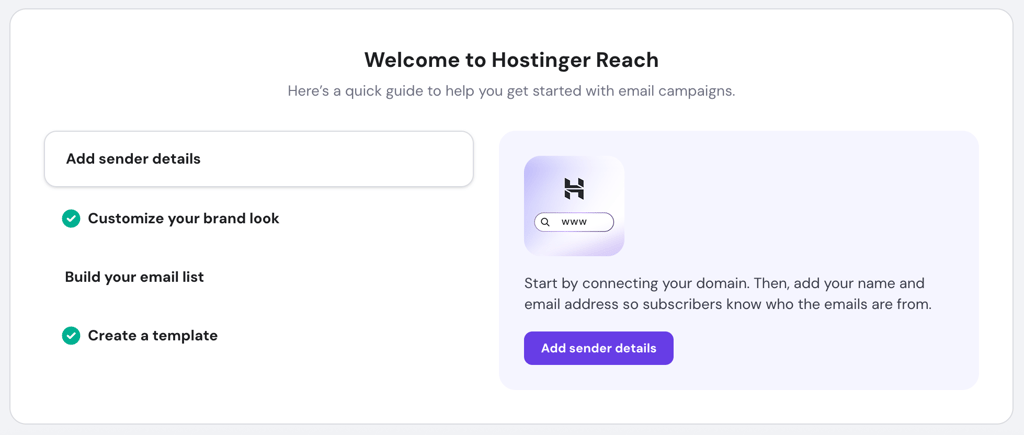
Yes, Hostinger Reach is excellent for sending email newsletters, especially if you’re just getting started. It’s an AI-powered email marketing platform that makes it easy to create professional campaigns.
When it comes to the criteria we mentioned above, Hostinger’s AI email marketing platform checks all the essential boxes. The platform uses AI to help you create emails without needing design or writing skills. You describe what you want, and it handles the layout and content for you.
For branding consistency, Reach lets you save your style settings so every email matches your brand. If you’re already using Hostinger’s site builder, the platform can automatically sync new subscribers from your website forms, simplifying list management.

2. Define your audience
Defining your audience means figuring out exactly who you’re writing to and what they care about. This isn’t just about demographics – it’s about understanding what your readers actually want to read.
Why does this matter so much? Because the same message hits differently depending on who’s reading it. A newsletter about productivity tips will sound completely different if you’re writing for busy parents, college students, or small business owners.
Think about the different groups that might be on your list:
- Existing customers. These people already know and trust your brand. They want updates, exclusive offers, and insider information. You can be more direct about sales and assume they understand your products.
- Potential customers. They’re interested but haven’t bought anything yet. These readers need more education and trust-building. Focus on helpful content that shows your expertise without being too pushy.
- General subscribers. Maybe they found you through a blog post or social media. They’re the least committed group, so you need to work harder to keep their attention. Think valuable tips, entertaining stories, and gradual relationship building.
For example, let’s say you run a fitness blog. Your existing customers might want workout videos and supplement recommendations. Potential customers need beginner guides and success stories. General subscribers probably want quick health tips and motivation.
Understanding these differences helps you tailor your email marketing campaign – from tone and content topics to email frequency and the specific actions you ask readers to take next.
3. Set clear goals
Every email you send should have a purpose. Setting specific goals helps you make better decisions about everything from subject lines to call-to-action buttons.
Without clear goals, you’ll find yourself sending random updates that don’t connect with your audience. You’ll also struggle to measure success because you won’t know what you’re trying to achieve in the first place.
Here are some common newsletter goals to consider:
- Drive website traffic. Maybe you want people to read your latest blog posts or check out new products. Your content should tease what’s on your site and give readers a compelling reason to click through.
- Build community engagement. This could mean getting replies to your emails, encouraging social media shares, or having people join your Facebook group. Your tone should be conversational, and you should ask questions that invite responses.
- Promote products or services. Sometimes you just want to make sales. But balance promotional content with valuable tips so you don’t sound like a constant sales pitch. This works for course creators who share tips with their promotions, or retail brands who include styling advice with product announcements.
- Establish expertise. If you’re a consultant or service provider, you might want to showcase your knowledge. Share insights, case studies, or behind-the-scenes content that demonstrates what you know.
- Stay top-of-mind. Sometimes the goal is simply to remind people you exist. This works well for businesses with longer sales cycles or seasonal services. Think real estate agents sending market updates or wedding photographers sharing recent work during engagement season.
The key is picking one clear goal per email campaign. Having a single focus keeps your message sharp and your readers engaged.
4. Design your template
Your email template is like the frame around a picture – it should make your content look good without stealing the spotlight. The best newsletter designs are clean, simple, and easy to read on any device.
Here’s what matters most:
- Keep it simple. Cluttered emails overwhelm readers. Stick to one or two fonts, use plenty of white space, and don’t cram too much into each section. Your readers should be able to scan your email in seconds and know what it’s about.
- Make it mobile-friendly. More than half of all emails get opened on phones. If your newsletter looks terrible on mobile, you’re losing a huge chunk of your audience. Test how your emails look on different screen sizes before you send them.
- Stay consistent with your brand. Use your brand colors, fonts, and logo so readers instantly recognize your emails. This builds trust and makes your business feel more professional.
The good news? You don’t need to design from scratch. Most email marketing platforms come with dozens of pre-made templates you can customize. Just pick one that matches your style and swap in your colors and content. Once you’ve got your design ready, take a look at these email newsletter best practices to make sure your layout, tone, and content strategy align for maximum reader engagement.
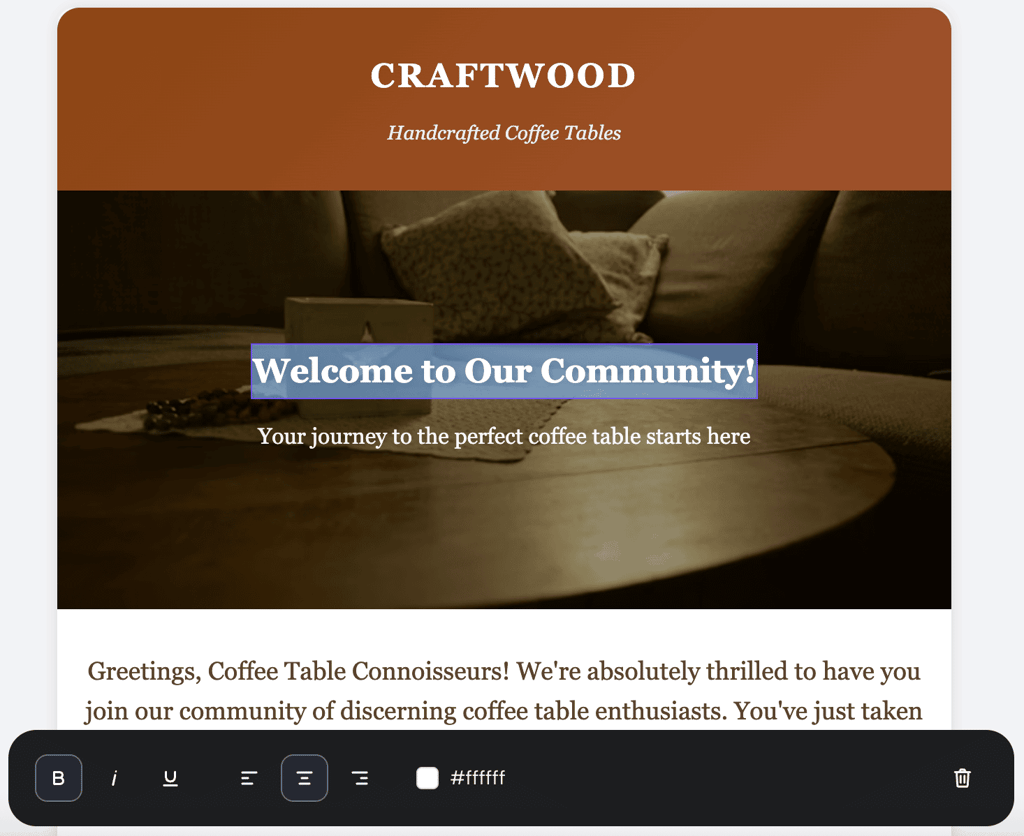
Built your site with Hostinger Website Builder?
Use Reach to get a template that matches your website’s design. Your emails will look like a natural extension of your brand, creating a seamless and professional experience.
5. Craft a catchy subject line
Your subject line is one of the first things people look at when deciding whether to open or delete your email. It doesn’t matter how amazing your content is if nobody opens the email to read it.
Think of your subject line like a movie trailer: it needs to give people just enough information to make them curious and want to read.
Here are several approaches that work:
Create urgency. Urgency taps into people’s fear of missing out by suggesting something valuable won’t be available much longer. This motivates people to act quickly rather than putting your email aside for later. Just don’t overuse this approach, or it loses its credibility.
❌ Instead of: Holiday Special
✅ Try: 50% off ends at midnight
❌ Instead of: Limited Time Offer
✅ Try: Only 3 spots left for Friday’s workshop
Spark curiosity. When you hint at valuable information without revealing everything, readers feel compelled to open the email to satisfy their curiosity. This works because our brains are wired to seek closure and complete information.
❌ Instead of: Newsletter #47
✅ Try: The mistake that’s costing you customers
❌ Instead of: New Blog Post
✅ Try: This changed everything for my business
Make it personal. Personalization makes your email feel like a one-on-one conversation rather than mass communication. When people see their name or feel like you’re speaking directly to them, it feels relevant and important to them.
❌ Instead of: Product Update
✅ Try: You asked for it, we built it
❌ Instead of: Welcome Email
✅ Try: Sarah, your account is ready to go
Use numbers. Numbers stand out in a crowded inbox, and our brains identify them quickly. Specific numbers also suggest concrete, actionable value rather than vague benefits.
❌ Instead of: Weekly Tips
✅ Try: 5 tools that cut my work time in half
❌ Instead of: Monthly Sales Report
✅ Try: We broke our sales record (here’s how)
Ask questions. Questions engage readers by making them think about their own situation. They create a mental conversation where people naturally want to know the answer, especially if the question touches on something they’re struggling with.
❌ Instead of: SEO Guide
✅ Try: Why your competitor’s website ranks higher
❌ Instead of: Time Management Tips
✅ Try: What if you could get 3 hours back each day?
Be direct. Direct subject lines work when you need to communicate important information clearly and efficiently. They’re particularly effective for transactional emails or when your relationship with subscribers is already established and they trust you to provide value.
❌ Instead of: Account Information
✅ Try: Your payment failed – update your card
❌ Instead of: Weekly Roundup
✅ Try: Here’s what you missed this week
Need inspiration for subject lines? Look at what’s already working. Check your inbox to see which subject lines catch your attention, browse popular newsletters in your industry to see what they’re doing, and scan headlines on news sites and social media posts that get a lot of engagement.
The key is adapting these ideas to fit your brand voice, not copying them. Keep a running list of subject lines that perform well for you, then create variations when you need fresh ideas.
6. Write valuable content
Valuable content means information that helps your readers solve problems, learn something new, or entertains them in a meaningful way.
The golden rule of newsletter content is simple: always give more value than you ask for. If every email is just a sales pitch, people will unsubscribe fast. But if you consistently help your readers solve problems or learn something new, they’ll look forward to hearing from you.
Here’s how to balance different types of content:
- Educational content. Share tips, tutorials, or insights related to your expertise. A fitness coach might include a quick workout routine, while a marketing consultant could break down a successful campaign strategy.
- Behind-the-scenes content. People love seeing the human side of businesses. Share your process, mistakes you’ve learned from, or what’s happening in your company. It builds connection and trust.
- Curated content. You don’t have to create everything from scratch. Share interesting articles, tools, or resources you’ve found, along with your take on why they matter. A web designer might share weekly design inspiration, and a business coach could highlight useful apps their clients are using.
- Story-driven content. Share customer success stories, case studies, or personal experiences that relate to your audience’s challenges. Stories are memorable and help people see themselves achieving similar results.
- News and updates. Keep your audience informed about industry trends, company news, or changes that affect them. This positions you as a reliable source of timely information.
- Promotional content. Yes, you can sell to your list, but make it about 20% of your total content. When you do promote something, explain the benefit clearly and make it feel like a natural recommendation.
The best part? You don’t have to write everything yourself anymore. Email marketing platforms like Hostinger Reach can help you write great marketing emails for you.
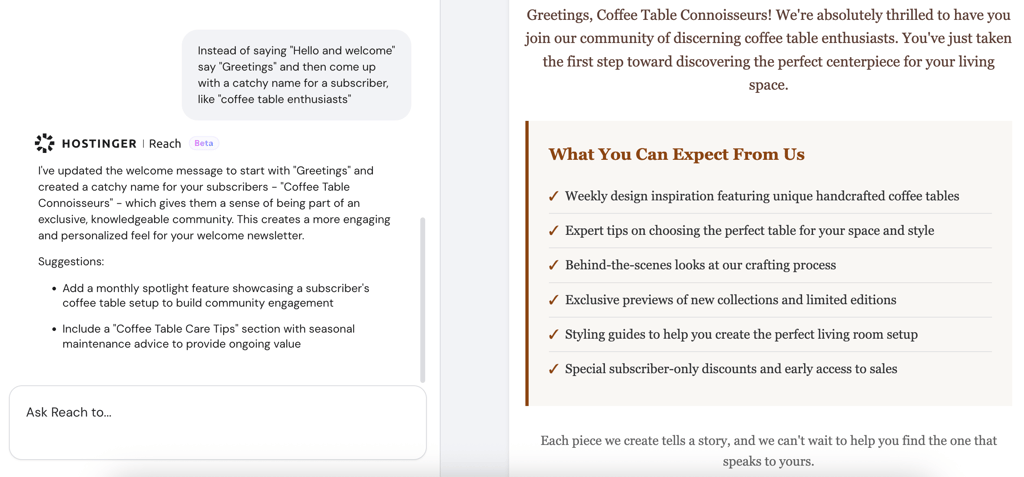
You just need to write effective prompts that tell the AI what kind of content you want, what tone to use, and what key points to cover.
Expert tip
📚Learn more about creating effective prompts with our prompt engineering guide.
7. Add visuals
Visuals are images, graphics, photos, and other elements that make your emails more engaging and easier to read. Text-heavy emails can be boring, so visuals break up your content, make it easier to scan, and help important information stand out.
You don’t need fancy graphics or professional photography, though. Simple, relevant images work just fine. The goal is to support your message, not distract from it.
Here are different types of visuals that work well in newsletters:
- Product photos. If you’re promoting something, show it. A clear product shot works better than paragraphs of description. Ecommerce stores can showcase new arrivals or bestsellers.
- Screenshots. Perfect for tutorials or software reviews. Instead of explaining every step, show your readers exactly what they should see on their screen.
- Simple graphics. Charts, infographics, or illustrated tips can make complex information digestible. A fitness trainer might include a simple workout diagram, or a financial advisor could share a budgeting chart.
- Behind-the-scenes photos. These add personality to your brand. Pictures of your workspace, team, or process help readers feel more connected to your business.
- GIFs. A well-placed GIF can add humor or demonstrate a process better than static images. They’re great for showing before-and-after transformations, step-by-step processes, or just Drake pointing approvingly at your new product.
Keep file sizes small so your emails load quickly, and always include alt text for accessibility. Most email platforms will compress images automatically, but it’s still good practice to resize large photos before uploading them.
8. Include a clear call to action (CTA)
A call to action is a specific instruction that tells your readers exactly what you want them to do next. Every email should have one clear next step, whether that’s clicking a link, making a purchase, or replying with feedback, and your CTA should connect directly to your email’s goal.
Here are examples of effective CTAs for different goals:
Driving traffic to your website:
- Read the complete tutorial
- See all 15 examples
- Get the full checklist
Building engagement:
- Reply and tell me your biggest challenge
- Share this with a friend who needs to see it
- Join the conversation on Instagram
Making sales:
- Claim your discount before it expires
- Add to cart – free shipping included
- Start your free trial today
Growing your community:
- Join our Facebook group
- Follow us for daily tips
- Invite a colleague to subscribe
When possible, make your CTAs stand out visually with buttons instead of plain text links, and keep the language action-oriented and specific.
Reach makes it easy to create attractive CTA buttons using its built-in AI features. But if you need more ideas, here are other AI content generators to check out.
9. Ensure legal compliance
Email marketing laws are regulations that govern how you can collect email addresses and send commercial messages to subscribers. These rules exist to protect people from spam and give them control over their inboxes.
Here are the main laws to keep in mind:
- GDPR (General Data Protection Regulation). This applies if you have subscribers in Europe. You need clear consent before adding someone to your list, and you have to explain what you’ll do with their data. Use double opt-in for new subscribers and keep records of when and how people signed up.
- CAN-SPAM Act. This covers emails sent in the United States. Your name and subject line can’t be misleading, you need a physical address in your emails, and unsubscribe requests must be processed within 10 days. You also can’t add people to your list without permission.
- CASL (Canada’s Anti-Spam Legislation). If you send emails to Canadian recipients, CASL requires express or implied consent before sending commercial messages. The penalties are severe, so be sure to identify yourself clearly in every email and include your physical address.
Even if you’re not based in these regions or don’t have subscribers there, it’s still best practice to comply with all three laws. This protects you from potential legal risks and ensures you’re following the highest industry standards.
Another important rule for email marketing is to always include an unsubscribe link. This isn’t just a legal requirement – it’s essential for maintaining your sender reputation and avoiding spam complaints that could hurt your email deliverability.
Most reputable email marketing platforms handle the technical compliance automatically. They’ll include unsubscribe links, manage opt-outs, and help you create compliant sign-up forms. But you’re still responsible for getting proper consent and being honest about what you’re sending.
10. Test and analyze your email
Testing and analyzing your email means experimenting with different elements of your newsletters and tracking the results to see what works best for your audience. You need to know what’s working and what isn’t so you can improve performance over time.
The good news is that most email marketing platforms track the vital stats automatically. You just need to know which numbers matter and what to do with them.
Key metrics to watch:
- Open rate. The percentage of people who opened your email. If this is low, your subject lines might need work, or you’re sending at the wrong time. Aim for 15-25% depending on your industry.
- Click-through rate. How many people clicked links in your email. This tells you if your content and calls-to-action are compelling. Even 2-5% is pretty good for most newsletters.
- Conversion rate. The percentage of people who took your desired action after clicking through. This could be making a purchase, downloading something, or signing up for an event.
- Bounce rate. How many emails couldn’t be delivered. A high bounce rate hurts your sender reputation and means your list needs cleaning. Keep it under 2% by removing old or invalid email addresses.
- Unsubscribe rate. If this spikes suddenly, you might be sending too often, or your content isn’t relevant anymore. Don’t panic over the occasional unsubscribe, but watch for patterns.
What to test:
- Subject lines. Try different approaches, such as questions, statements, or shorter subject lines. Send the same email with two different subject lines to small groups and see which performs better.
- Send times. Your audience might check their email at different times than you think. Test sending on other days of the week or times of day to find your sweet spot.
- Call-to-action buttons. Try different colors, text, or placement. Test which phrases work better than others and whether certain colors outperform existing ones.
- Email length. Some audiences prefer quick updates, while others want detailed content. Test shorter and longer formats to see which get more engagement.
- Template design. Test different layouts, image placement, or color schemes. Sometimes a simple text email outperforms a heavily designed one, or vice versa.
- Personalization. Try using the subscriber’s name in the subject line or email content versus generic messaging. Personal touches often boost engagement.
Start with one element at a time and track results. Most email platforms let you split test by sending different versions to small portions of your list, then automatically sending the winning version to everyone else.
How to grow your email list?
You can grow your email list by focusing on proven strategies that attract subscribers who actually want to hear from you.
Start with website sign-up forms at the end of blog posts, and offer something valuable in exchange, like a free guide, discount code, or exclusive content. These work especially well when they solve real problems your audience has.
You can also promote your newsletter on social media, run contests where entering requires an email subscription, and have pop-up forms show when visitors are about to leave your site. Start with website sign-up forms since they’re the most straightforward to implement, then add one new strategy each month once you see results.
What makes email marketing successful?
Email marketing is successful when you focus on building real relationships instead of just pushing products. The best newsletters feel like getting an email from a friend who happens to know a lot about something you’re interested in.
The key is to know your audience deeply. Effective email marketers understand exactly who they’re writing to and what those people care about. This means your content addresses what matters most to them, and your tone matches what resonates with your readers.
Want to improve your email newsletter results?
Get more practical strategies and proven email marketing tips.
What are email marketing mistakes to avoid?
The top email marketing mistakes to avoid include sending too many promotional emails, being inconsistent with your sending schedule, and focusing too much on yourself instead of your subscribers.
Other common mistakes include ignoring your audience’s interests, sending generic content that doesn’t match what people want to read, and forgetting to test your campaigns.
Time to build your first email newsletter
You now have everything you need to create an email newsletter that people actually want to read.
Start by choosing an email marketing platform like Hostinger Reach, defining your audience, and setting clear goals for what you want to achieve. Then focus on creating valuable content with compelling subject lines and clear calls to action.
Remember, the best newsletters build relationships over time by consistently delivering value to subscribers. When you help solve problems and share insights that matter to your readers, they’ll trust your recommendations and look forward to your emails.
Your audience needs to hear what you have to say, so go make it happen.
This article is a localized version of How to create an email newsletter: A step-by-step guide, originally published in English.

Simon is a dynamic Content Writer who loves helping people transform their creative ideas into thriving businesses. With extensive marketing experience, he constantly strives to connect the right message with the right audience. In his spare time, Simon enjoys long runs, nurturing his chilli plants, and hiking through forests. Follow him on LinkedIn.

Miglė Padelytė is the Product Manager for Reach at Hostinger, where she focuses on creating an exceptional user experience and driving business growth. She's an empathy-driven, hands-on leader who loves diving deep to solve real user problems and tackle complex challenges. With a background in fintech, Miglė is comfortable with data analysis and uses her technical skills to make smart, informed decisions. Follow her on LinkedIn.