Black Friday marketing strategy: How to plan a successful campaign
Oct 08, 2026
/
By Simon L.
/
16 min Read
A Black Friday marketing strategy is a coordinated plan that connects your campaign goal, audience, offer, timing, and marketing channels. It turns Black Friday marketing from a pile of disconnected promotions into one campaign where every channel pushes the same message.
There are five stages to building the strategy:
- Define your campaign goals and KPIs.
- Identify your target audience and customer segments.
- Choose your Black Friday offer.
- Create a campaign timeline.
- Select the marketing channels that reach your audience.
Once the plan is set, fill it with tactics. There are 15 Black Friday marketing ideas to run across email, landing pages, social media, and paid ads, and the right mix follows from the goal you set in stage one. Campaign examples and clear metrics then show whether the strategy worked.
How to create a Black Friday marketing strategy
To create a Black Friday marketing strategy, work through five planning decisions in order: set the goal, define the audience, create the offer, plan the timeline, and pick the channels. Each decision narrows the next one, so skipping ahead usually means redoing work later.
Define your campaign goals and KPIs
Campaign goals are the measurable outcomes you want Black Friday to deliver, and you set them before choosing a single tactic. A goal like “sell more” gives you nothing to plan against; a goal like “increase average order value by 15%” tells you exactly which ideas belong in your campaign.
Common Black Friday campaign goals include:
- Revenue and conversions. Total sales, conversion rate, and revenue per channel.
- Customer acquisition. New customers gained during the campaign and their acquisition cost.
- Average order value (AOV). How much each shopper spends per transaction.
- List growth. Email sign-ups collected before and during the sale.
- Retention. Repeat purchases from existing customers and gift card redemptions.
- Brand awareness. Reach, engagement, and branded search volume.
Pick one primary goal and up to two supporting ones. The primary goal determines where your budget and effort go. For example, if your goal is to grow your email list, focus on lead capture and early access; if your goal is to increase AOV, focus on bundles and spending thresholds.
Identify your target audience and customer segments
Your target audience determines the message, the offer, and the channels, so define your customer segments before creating your campaign. A first-time visitor needs a different push than a customer who has bought from you three times. Use Black Friday consumer behavior and shopping trends to understand how different shoppers behave during the sale period.
The segments that matter most during Black Friday are:
- New prospects who found you through ads or social content.
- Website visitors who browsed your site but never bought.
- Subscribers who joined your list but haven’t purchased yet.
- Previous buyers with one or two past orders.
- Loyal and VIP customers who buy repeatedly or belong to your loyalty program.
Decide which segments your campaign prioritizes before moving on. This is where personalization starts: the segments you define now become the audiences for your emails, ads, and offers later in the campaign.
Choose your Black Friday offer
Your Black Friday offer is the deal your entire campaign promotes, and it should follow directly from your goal and audience. An acquisition goal aimed at new customers might favor a percentage or fixed discount that encourages first-time purchases, while a retention goal for existing customers might favor early access, loyalty bonuses, or gift cards. Either way, deciding on your pricing strategies for Black Friday would be essential before the campaign starts.
The main offer types are percentage discounts, fixed-amount discounts, bundles, tiered rewards, early access, limited editions, gift card bonuses, and value-added extras such as free shipping or a free service upgrade.
Deep discounts are not the only way to create a strong Black Friday offer. Exclusivity, bundles, and limited releases create value without cutting into margins, which matters for service businesses and premium brands that discount rarely. The strategy sections below break down how each offer type works in practice.
Create a Black Friday campaign timeline
A Black Friday campaign timeline splits your marketing into four stages: pre-Black Friday, the Black Friday weekend, Cyber Monday, and post-sale follow-up. Plan and start promoting early so shoppers have time to discover the offer and become familiar with your campaign before the main sales period.
Work backward from when Black Friday happens: in 2026, Black Friday falls on November 27 and Cyber Monday on November 30.
Stage | When | Focus |
Pre-Black Friday | 6 to 8 weeks out (early October) | Plan goals, offer, and creative; from 3 to 4 weeks out, tease with awareness content, list growth, and early access invitations |
Black Friday weekend | November 27-29, 2026 | Launch: full offer live, peak send frequency, retargeting |
Cyber Monday | November 30, 2026 | Intensify: restocks, low-stock urgency, last call for hesitators |
Post-sale | Week of December 1 onward | Follow up: thank-yous, second-chance offers, retention, results review |
Keep the sales window open through Cyber Monday: it remains the single biggest online shopping day of the year, and it catches the people who waited out the weekend hoping for a better deal.
A four-day window also means four days of peak traffic, so prepare your ecommerce store for Black Friday in parallel with the marketing plan.
Pro tip
Lock your offer and creative assets at least two weeks before your first teaser goes out. This gives you time to check everything and avoid last-minute mistakes with prices, links, and messaging.
Choose your marketing channels
Choose marketing channels based on where your target segments already are and what your primary goal needs each channel to do. Three channels executed well beat six channels running on autopilot.
Assign each channel a role and a share of your ecommerce marketing budget before the campaign starts.
The core Black Friday channels are:
- Email and newsletters. The highest-control channel for reaching subscribers and past buyers directly.
- Website and landing pages. Every other channel works to drive traffic to your website, and this is what turns visitors into buyers.
- Organic social media. Builds anticipation and reach in the weeks before the sale.
- Paid advertising. Reaches beyond your existing audience and retargets shoppers who browsed without buying.
- Offline channels. In-store posters, local ads, and events for businesses with a physical location.
Every channel promotes the same offer with the same message. What changes per channel is the tactic, and that is what the 15 Black Friday marketing ideas below cover.
Black Friday marketing strategies and ideas
There are 15 Black Friday marketing strategies that cover every stage of the campaign, from early awareness to post-sale retention. The table maps each one to its main purpose, primary channel, and campaign stage so you can pick the ones that match your goal.
# | Strategy | Main purpose | Primary channel | Campaign stage |
1 | Build early awareness | Get on shoppers’ radars before offers flood in | All channels | Pre-Black Friday |
2 | Reward loyal customers with early access | Grow your list and strengthen retention | Pre-Black Friday | |
3 | Plan an email and newsletter campaign | Drive repeat traffic to your offer | All stages | |
4 | Create a dedicated landing page | Convert campaign traffic in one place | Website | All stages |
5 | Bundle products or services | Raise average order value | Website | Black Friday window |
6 | Use tiered discounts or spending thresholds | Push carts past spending levels | Website | Black Friday window |
7 | Create urgency with limited-time offers | Turn interest into immediate action | All channels | Black Friday window |
8 | Launch an exclusive or limited-edition offer | Create demand without deep discounts | Website, social media | Black Friday window |
9 | Use social media to generate hype | Build reach and anticipation | Organic social media | Pre-Black Friday, Black Friday window |
10 | Run paid ads and retarget warm audiences | Recover warm visitors and abandoned carts | Paid advertising | Black Friday window |
11 | Personalize promotions for each segment | Increase relevance and conversion | Email, paid ads | All stages |
12 | Keep promotions consistent across channels | Remove friction between channels | All channels | All stages |
13 | Use reviews and user-generated content | Reduce purchase hesitation | Website, ads | Black Friday window |
14 | Promote gift cards and vouchers | Capture undecided shoppers | Website, email | Black Friday window |
15 | Collaborate with brands or creators | Reach new, relevant audiences | Social media, partnerships | Pre-Black Friday, Black Friday window |
You don’t need all 15: start with the ones tied to your primary goal, then layer in supporting tactics as your team’s capacity allows.
1. Build early awareness
Early awareness means getting your campaign on shoppers’ radars weeks before Black Friday, while there is less competition for their attention. By mid-November, every inbox and social media feeds are saturated with offers, so shoppers are more likely to notice and open deals from brands they already recognize.
To build awareness early:
- Announce that a sale is coming without revealing the details. Holding back the numbers gives you a reason to email again when you reveal them.
- Publish save-the-date content across your channels with the exact start date.
- Release previews of one or two headline deals in the final week to sharpen anticipation.
A local bookstore could post a teaser graphic a month out, follow with a save-the-date a week later, and reveal its single best deal three days before the sale. The channel-specific execution belongs to the dedicated email and social media strategies.
2. Reward loyal customers with early access
Early access gives your best customers the deals before everyone else. It makes loyal buyers feel valued, so they keep coming back, and it gives everyone else a concrete reason to join your email list before the sale. Offer early access to:
- Newsletter subscribers, with a private link sent 24 to 48 hours before the public launch.
- Loyalty program and VIP members, as a headline perk of the program itself.
- Top spenders or long-term customers, even without a formal program, through a personal invitation.
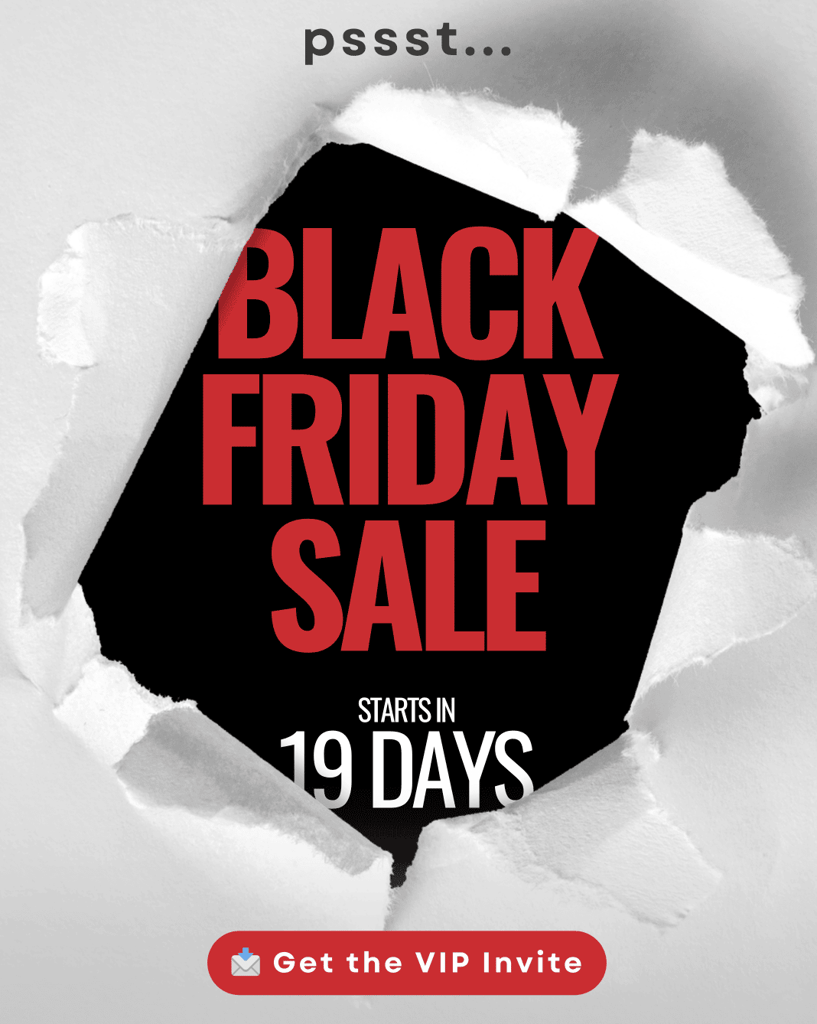
A clothing brand could email subscribers a VIP invitation with early access to the full sale, then promote “join the list for early access” everywhere else. New sign-ups get the perk immediately, which converts list growth into first purchases within the same campaign.
3. Plan a Black Friday email and newsletter campaign
A Black Friday email campaign is a planned sequence of sends, not a single blast on the day. Each email has one job, and together they carry your audience from learning about the upcoming sale, to making a purchase, to follow-up after the sale.
A complete Black Friday email marketing strategy covers seven sends, each with its own slot on the calendar:
- Teaser, two weeks before launch.
- Early access, 24 to 48 hours before the public start.
- Launch, the morning the sale opens.
- Mid-sale reminder, on the second day.
- Final hours, 6 to 8 hours before the sale closes.
- Cyber Monday, the morning of November 30.
- Post-sale thank-you, within 48 hours of each purchase.
Segment the list before scheduling anything, since subscribers who already bought shouldn’t keep receiving discount reminders.
Black Friday can break email deliverability for senders who spike volume overnight. To avoid this, remove inactive subscribers in October, increase your sending volume gradually through the teaser stage, and never use purchased lists. If your emails start landing in spam during the sales window, recovery takes weeks, and the sale will be over first.
A/B test subject lines on the teaser send and apply the winner’s style to the rest of the sequence. Instead of designing every email from scratch, borrow proven layouts from these Black Friday newsletter examples and adapt them to your offer.
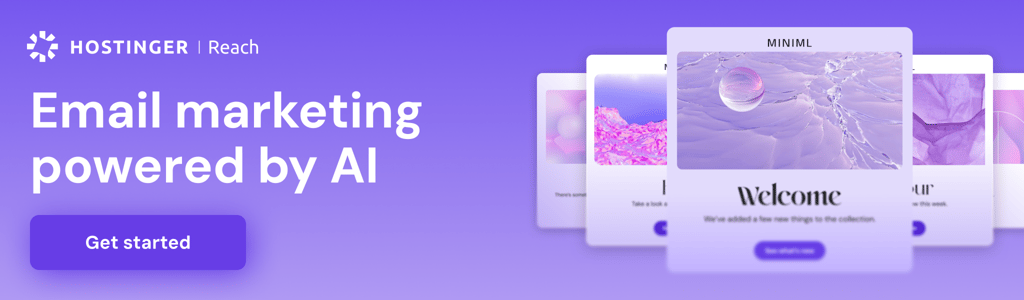
An email marketing tool like Hostinger Reach lets you build the sequence once, segment recipients, and schedule every send in advance, so you can focus on monitoring the campaign during Black Friday week instead of writing emails at the last minute.
4. Create a dedicated Black Friday landing page
A dedicated Black Friday landing page gives every email, ad, and social post one focused destination that matches the message shoppers clicked on. Sending campaign traffic to your homepage can make shoppers search for the deal instead of finding it right away, which can lead to fewer purchases.
The strongest Black Friday landing page examples share the same six elements:
- The offer, stated in the first screen without scrolling.
- The deadline, ideally with a visible countdown.
- One clear call to action repeated down the page.
- Campaign visuals consistent with your ads and emails.
- Social proof, such as review scores or customer photos.
- A short FAQ-style block answering shipping and returns questions.
You can publish the page with an ecommerce platform and a pre-made template, then reuse the structure every sales season. Keep the page light too, since campaign images, countdown widgets, and popups are what usually slow a landing page under peak traffic; run the Black Friday website performance checks after the final banners go live. Take the page down after Cyber Monday instead of leaving an expired offer live.
5. Bundle products or services
Bundling combines multiple products or services into a single package at a single price. It can increase the average order value while giving customers a better deal. The key is to create bundles that meet a real customer need, not just offer a lower price.
Group complementary items that are naturally bought together or used in sequence:
- Retail. A skincare brand bundles a cleanser, serum, and moisturizer into a complete morning routine kit.
- Services. A spa packages a massage, facial, and manicure into one relaxation deal.
- SaaS and digital. A software company pairs its core plan with a premium add-on and onboarding session.
- Food and hospitality. A café sells a coffee, a pastry, and a reusable cup as a winter set.
Avoid grouping unrelated slow sellers into a “deal”: shoppers spot filler instantly, and a weak bundle damages the perceived value of every item in it.
6. Use tiered discounts or spending thresholds
Tiered discounts increase the reward as the cart value grows, which encourages shoppers to add one more item to reach the next level. Bundles give shoppers a fixed package, while tiered discounts let them choose their own products and get a better deal when they spend more.
A practical three-level structure looks like this: spend $75 and get 10% off, spend $150 and get 20% off, spend $250 and get 25% off plus free shipping. The jump between levels has to feel reachable, since a threshold far above a typical cart motivates nobody.
Run each tier through the same discount math you used to price the main offer. A 25% top tier on a low-margin category turns your biggest sales day into a loss.
Pro tip
Set the first threshold 15% to 20% above your current average order value. That's close enough for most shoppers to reach with one extra item, which is exactly the behavior the tier exists to create.
7. Create urgency with limited-time offers
Urgency shortens the decision window, so shoppers act on the spot instead of comparison-shopping until the deal expires. Black Friday is built on it, but it only works when the limits are real.
During the sales window, apply urgency through:
- Flash sales lasting a few hours, each promoted on its own.
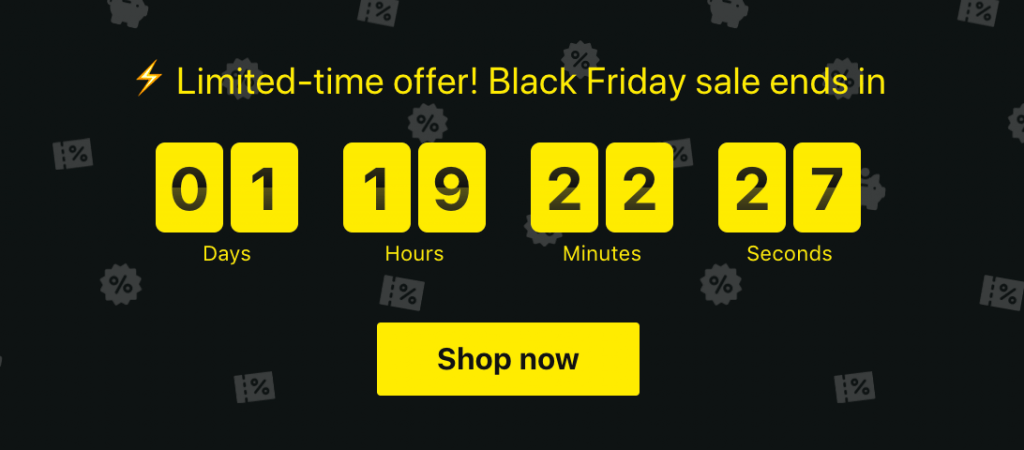
- Countdown timers on the landing page and in final-hours emails.
- Genuine stock indicators on products that are actually running low.
- Final-hours messaging in the last 6 to 12 hours of the sale.
Physical stores can run the same play with door-buster deals for the first 50 customers or hourly specials announced in-store.
Genuine urgency ends when the timer ends. If the “last chance” deal reappears three days later, customers notice – and next year’s countdown means nothing to them.
Fake discounts carry legal risk, not just reputation risk. In the EU, the Omnibus Directive requires displaying the lowest price from the 30 days before a promotion, so inflating prices in early November to advertise a bigger Black Friday discount can lead to fines.
8. Launch an exclusive or limited-edition offer
An exclusive offer creates demand through what makes the product special, rather than through a large discount. Limited editions, Black Friday-only bundles, product drops, and one-off service packages give shoppers a reason to buy that that competitors can’t easily match.
Exclusivity and urgency work differently. Urgency limits the time to claim an offer, while exclusivity limits the offer itself: once the run sells out, it’s gone regardless of the calendar.
This strategy fits businesses that protect their margins. A bakery can sell a Black Friday batch of pastry available one day per year. A design studio can open five project slots at a fixed package price. A coffee roaster can release a numbered, single-origin holiday roast. None of these depends on a percentage discount, and each gives loyal customers a unique reason to show up.
9. Use social media to generate hype
Organic social media builds the anticipation your campaign needs before the sales window opens, then keeps the audience engaged while it runs. Match the content to the campaign stage:
- Teasing stage. Countdown posts, behind-the-scenes previews, and short-form video hinting at the headline deals.
- Launch. A coordinated announcement across every profile the moment the sale opens, followed by product demos and Stories highlighting individual offers.
- Final hours. Live video on Instagram or TikTok showing the biggest remaining deals, with a countdown Story pushing the deadline.
Giveaways work in the teasing stage: ask followers to tag a friend for a chance at early access or a gift card, which expands reach right when awareness matters most. Skip generic trending hashtags, though: a niche tag your actual audience follows outperforms a broad one your buyers never search.
10. Run paid ads and retarget warm audiences
Paid ads extend your campaign beyond your existing audience, and retargeting brings back the shoppers who almost bought. Spend on warm audiences first: past visitors, engaged social followers, subscribers who clicked without buying, and anyone who left items in their cart.
Abandoned carts are the biggest recoverable pool. The average online cart abandonment rate sits at 70.22%, according to Baymard Institute, and Black Friday traffic multiplies the absolute number of those lost carts. A retargeting ad showing the exact abandoned product with the active discount is the shortest path back to checkout.
Keep the setup simple: paid social and search ads for reach, retargeting to bring back visitors, and ads that look like the page they lead to. If the ad promises 40% off, the page it leads to shows 40% off in the same visual style.
Ad costs peak during Cyber Week because every retailer bids at once. Set your budgets and launch your campaigns early in November, so the algorithms optimize before the expensive days arrive.
11. Personalize promotions for different audience segments
Personalization sends each audience segment the offer they’re most likely to act on, rather than a single generic discount blasted to everyone. The segments you defined in the planning stage now become campaign audiences with distinct treatments.
Email carries most of this work, and email list segmentation is where it starts: even splitting the list into buyers and non-buyers outperforms a single send. In practice, personalized treatment means:
- New prospects see acquisition offers and social proof in ads.
- Warm visitors get retargeted with the products they browsed.
- Subscribers who never bought receive a first-purchase incentive on top of the sale price.
- Previous buyers receive recommendations based on their last order.
- Loyal customers receive early access and a personal thank-you offer.
The treatments only pay off if the offers genuinely differ, so resist recycling the same discount under five different subject lines.
12. Keep promotions consistent across channels
Consistency means a shopper sees the same offer, discount, dates, visuals, and call to action on every channel they touch. During Black Friday, the average buyer moves across several channels from discovery to checkout, and every mismatch along the way costs sales.
The classic failure: an ad promises 40% off, the landing page shows 25%, and the shopper leaves feeling misled. No individual channel did anything wrong; the campaign did. The same mismatch now reaches shoppers before they click, because AI shopping tools summarize prices and offers straight from your pages, so preparing your store for Black Friday in AI search starts with the same single source of truth.
Prevent it with a single source of truth: keep a single campaign document listing the offer details, discount amounts, start and end dates, approved visuals, CTA copy, and require that every email, page, ad, and in-store sign be built from it. When the offer changes mid-campaign, the document changes first, and every channel follows as fast as its format allows.
This is the execution side of the channel plan you made earlier: channels were chosen to work together, and consistency is what “together” looks like in practice.
13. Use reviews, testimonials, and user-generated content
Social proof reduces purchase hesitation at the exact moment shoppers compare your offer against a dozen others. A discount says the price is good; a hundred reviews say the product is.
Put proof where the buying decision happens:
- Landing pages. Show the overall star rating next to the CTA, along with two or three specific reviews.
- Promotional emails. One strong testimonial per email, tied to the featured product.
- Ads. Customer photos and short video clips outperform studio shots for retargeting audiences.
- Social posts. Reshared customer content and creator reviews during the sales window.
Service businesses run the same play with client results and before-and-after work: a salon’s transformation photos or an agency’s project outcomes carry the same weight as product reviews. Collect the material in October, so it’s ready when the campaign assets are built.
14. Promote gift cards and vouchers
Gift cards capture shoppers who want your deal but can’t decide on an item, turning one Black Friday sale into two visits: the buyer today and the recipient later.
The strongest Black Friday tactic is bonus value: sell a $100 gift card with a bonus $20 voucher attached. The buyer gets more than they paid for, you take the revenue before anything ships, and the voucher brings someone back into the store after Black Friday.
Gift cards fit service businesses especially well:
- A restaurant sells holiday dinner gift cards.
- A gym offers a 10-class pass card.
- A salon or spa packages a treatment voucher as a ready-made gift.
Promote them hardest in the final hours of the sale, when undecided shoppers are out of time to research products.
15. Collaborate with complementary brands or creators
A collaboration puts your Black Friday offer in front of another audience that already trusts the messenger. The right partner shares your target audience without competing for the same sale: a gym and a health food store want the same customer, but never for the same purchase.
Affiliates and partners, including social media influencers, drove 21.9% of US online revenue on Black Friday 2025, according to Adobe Analytics – up from 19.6% the year before.
Formats that work during Black Friday:
- Joint bundles. A café and a bookstore sell a book-and-brew set available in both shops.
- Creator partnerships. A niche creator reviews your product and shares an exclusive discount code with their audience.
- Cross-promotions. Customers who spend over a set amount at one business get a discount at the partner’s.
- Joint giveaways. Both audiences enter, both brands grow their lists.
Agree on the offer details, tracking codes, and content schedule at least three weeks out, since your partner’s campaign calendar is as full as yours.
The video below covers nine of the fifteen strategies above, plus a hero-offer framework not included in this list.
How to measure your Black Friday marketing strategy
Measure your Black Friday marketing strategy against the goals and KPIs you set in the planning stage, not against a general feeling that the weekend went well. Total revenue doesn’t tell the whole story: a record sales day can still be unprofitable if it costs too much to acquire customers.
Match the email marketing performance metrics to your primary goal:
- Revenue goals: total sales, conversion rate, and revenue by channel.
- Acquisition goals: new customers and customer acquisition cost (CAC).
- AOV goals: average order value against your pre-campaign baseline.
- List growth goals: sign-ups collected and their first-purchase rate.
- Ad-driven campaigns: return on ad spend (ROAS) and click-through rate (CTR).
- Email campaigns: open, click, and conversion rates per send.
Compare channels and segments, not just totals: if email drove 40% of revenue on 5% of the budget, that channel earns a bigger share of next year’s budget, and the channels that cost the most per sale get reworked or cut. The same reading applies to segments, so a segment that converted well on a modest offer justifies a stronger one next season.
Set up Google Analytics 4 (GA4) before the campaign so channel attribution is ready on day one, and track your sends against standard metrics.
Run A/B tests while the campaign is live: subject lines on the teaser email, CTA copy on the landing page, and creative variants in retargeting ads. Small samples decided fast are better than perfect tests decided in December.
If you ran a campaign previous Black Friday, benchmark against it. Year-over-year comparison is what separates a good campaign from a good market.
Pro tip
Tag every campaign URL with UTM parameters, the short tracking codes added to a link that tell your analytics tool where each visitor came from. Without them, Black Friday traffic from email and social gets mixed together, making it difficult to see which channels are driving results.
The metrics tell you what worked. Real campaigns show what that looks like from the outside.
Best Black Friday marketing campaigns for inspiration
These three campaigns each demonstrate a core Black Friday strategy in practice: coordinated urgency, audience-focused landing pages, and exclusivity over discounts.
Hostinger
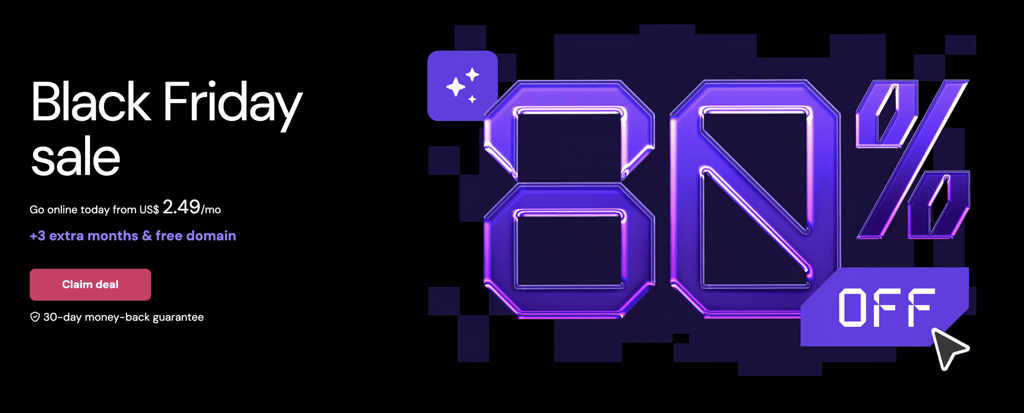
For its 2025 Black Friday campaign, Hostinger offered up to 80% off web hosting products, with separate deals for new customers and returning ones. You can explore the current Hostinger Black Friday deals to see how these seasonal offers are presented in the latest campaign.
The campaign demonstrates coordinated offer structure and urgency. New visitors saw a steep first-purchase discount with a free domain included, while existing customers received special pricing on upgrades and renewals, covering both acquisition and retention goals in one campaign.
The takeaway: split your offer by audience segment, then hold the design and deadline consistent everywhere the offer appears.
Etsy
Etsy’s holiday gift guides turn its Black Friday traffic into guided product discovery. Instead of one wall of discounts, the guides organize deals by recipient and theme, such as gifts for kids or eco-friendly picks, so shoppers who don’t know what they want still find something to buy.
The campaign demonstrates the landing page strategy applied at scale. Each guide is a focused destination with a clear audience, festive seasonal visuals, and categories that match how gift shoppers actually think. Etsy then promotes the guides across email and social media the way other brands promote individual products.
The takeaway: when your audience includes undecided gift buyers, a curated guide converts better than a discount grid.
Record Store Day
Record Store Day’s Black Friday event fills independent record shops with exclusive, limited-edition releases available only in person. Hundreds of stores participate, and the releases exist nowhere else.
The campaign demonstrates exclusivity as a complete alternative to discounting. The limited availability is genuine, the products are collectible, and the in-person requirement turns shopping into an event customers plan for weeks in advance. Fans queue for records at full price on the biggest discount day of the year.
The takeaway: a Black Friday campaign doesn’t need a percentage sign. Record Store Day fills shops with full-price buyers by making the offer scarce instead of cheap.
What to do after Black Friday
After Black Friday, shift the campaign from selling to keeping the customers you gained. Work through four follow-up moves:
- Extend into Cyber Monday. Prepare a fresh set of digital-only deals rather than rerunning Friday’s offers, since shoppers who waited out the weekend expect something new.
- Send the post-sale sequence. A thank-you email to new customers with a modest offer on their next purchase, then shipping updates and a review request once orders arrive.
- Segment your new customers. Separate one-time deal seekers from shoppers whose first order suggests repeat potential, and market to each differently through December.
- Retarget the near-misses. Shoppers who browsed during the sale but didn’t buy are warm through the holiday season, so keep them in your gift-focused December campaigns.
Then document the results while they’re fresh. Record what each channel delivered, which offers moved, and what you’d cut next year. Add the broader Black Friday campaign lessons other businesses learned the hard way.
One campaign’s data is next year’s head start. When you start planning again, begin with the operational side and prepare your online store for Black Friday well before the marketing calendar fills up.
All of the tutorial content on this website is subject to Hostinger's rigorous editorial standards and values.

Simon is a dynamic Content Writer who loves helping people transform their creative ideas into thriving businesses. With extensive marketing experience, he constantly strives to connect the right message with the right audience. In his spare time, Simon enjoys long runs, nurturing his chilli plants, and hiking through forests. Follow him on LinkedIn.